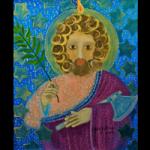
Showing posts with label novena. Show all posts

Monday, October 28, 2019

October 28th, Feast of St. Jude Thaddeus


Saint Jude, cousin and friend of our Lord,
Christ chose you to be his Apostle.
You learned from him the message of our salvation.
Join us in our prayers today.

Saint Jude, you helped lay the foundation of Christ's church.
You took the message of Christ's love to many distant place.
Join us in our prayers today.

Saint Jude, you died a martyr for the love of Jesus.
You inspire us by your generous love.
Join us in our prayers today.

Saint Jude, you share the happiness of heaven.
You have sealed forever your friendship with Jesus.
Join us in our prayers today.

Saint Jude, you share the name of Judas who betrayed our Lord, and many have forgotten you.
But we have not forgotten you.
We pray to you, patron of hopeless cases and of those who despair.
We are sinners, but we trust in God's mercy and love.

Intercede for us, that our faith be kept strong in our sorrows and trials.
Help us to see in our troubles God's plan for our salvation.

Intercede with God for us in our present needs.

Join us as we pray in Jesus' name.

Amen.

Prayer of the Catholic Church of Saint Jude, Fort Wayne, Indiana, U.S.A. Source link here.

Monday, December 25, 2017

Sunday, October 15, 2017

Sermon: Pray Without Ceasing

A sermon by Rev. Keenan Kelsey of Noe Valley Ministry, Presbyterian Church, San Francisco, California, U.S.A., given February 20, 2005 (source link here).

Thessalonians 5:14-24
And we urge you, beloved, to admonish the idlers, encourage the faint-hearted, help the weak, be patient with all of them. See that none of you repays evil for evil, but always seek to do good to one another and to all. Rejoice always, pray without ceasing, give thanks in all circumstances; for this is the will of God in Christ Jesus for you. Do not quench the Spirit. Do not despise the words of prophets, but test everything; hold fast to what is good; abstain from every form of evil. May the God of peace himself sanctify you entirely; and may your spirit and soul and body be kept sound and blameless at the coming of our Lord Jesus Christ. The one who calls you is faithful, and he will do this.


When I think of the phrase, Pray Ceaselessly, Pray without Ceasing, I think of Naomi Anna Greenleaf. Many of you know her – a former NVM member who lives in southern California, and visits occasionally. She writes us a letter each month. For a woman who feels like prayer is often an empty exercise for her, she is the most faithful and loving and determined pray-er I know! Here is an excerpt from her last letter to us...

I’m sure you’ve heard me complain over and again about my barren spiritual life, how in prayer and meditation I never hear anything by the rattle-clatter of my own mind, how I can’t seem to find the voice of God. Well, that all changed as I was repeating the Jesus prayer to my self. (I have undertaken the discipline of constant prayer that is, repeating a short prayer over and over as I go about my daily business. The Jesus Prayer has two forms: long form: “O Lord Jesus Christ, Son of God, have mercy on me, a sinner.” Short form: “O Lord Jesus Christ, have mercy.” I use the short form.) As I was repeating the prayer, the thought came to me to pay closer attention to it. So I tried to imagine Jesus listening to me as I prayed. As I did so, I suddenly became very aware of my physical body. This might not seem remarkable to you, but I happen to be a person who lives “in the head” most of the time, and rarely do I feel my body…So this new sensation gave me a lot of joy…I thought to myself, “What a surprise! Is this what it’s like to contact Christ, am I finally learning to pray?” And I was very pleased and happy and continued praying. Then came a distraction, a temptation.”

Here Naomi Anna describes a desire to taste a Christmas gift of homemade marmalade. She got all involved in trying to get the top off “To make a long story short, I finally got the jar open and tasted the marmalade and then put it away. Then I tried to go back to my prayer. Nothing happened. I couldn’t get connected. “My God” I thought, “What have I done? Have I traded Christ for a spoonful of marmalade?” Well I know for a fact that Christ would not abandon me just because I was straying, It was I who had abandoned him. The connection was still very tender…I felt sure if I was patient, persevering, I would get the feeling back. But that was two weeks ago. But do you want to know something? As I was sitting here, writing this letter to you, the feeling started to come back…Maybe it’s true that our connections with one another can lead us to God. Maybe it’s high time I forgive myself, and get back to praying…”

"Pray ceaselessly" says Paul. This is the center phrase of Paul’s final instruction in his first letter to the church in Thessalonica. This was the capital city in Macedonia, a bustling seaport, with a new church largely gentile in membership. He wrote to give the new converts both instruction and encouragement in their trials. And he reminds them, Pray without ceasing.

Indeed, this is the center of Paul’s own theology, Paul’s way of being in the world. Every letter he wrote begins with thanksgiving and prayer for the church members and their work. He begins this letter to Thessalonians: “We always thank God for all of you, mentioning you in our prayers.”

Paul exhorts prayer in almost every epistle – in Romans: “Rejoice in hope, be patient in suffering, persevere in prayer.” In First Corinthians: “What should I do then? I will pray with the spirit, but I will pray with the mind also.” In Ephesians: “Pray in the Spirit at all times in every prayer and supplication.” In Colossians: “Devote yourselves to prayer, keeping alert in it with thanksgiving. At the same time, pray for us as well that God will open to us a door for the word, that we may declare the mystery of Christ…” To the Philippians: “My prayer for you is that you will have still more love - a love that is full of knowledge and wise insight.” And my very favorite expression of prayer, again in Romans: “Likewise the Spirit helps us in our weakness; for we do not know how to pray as we ought, but that very Spirit intercedes with sighs too deep for words.”

Sighs too deep for words.

Other people have used other words to describe this practice to which we are called, this discipline, this attitude, which is meant to hold, inform, sanctify, enrich, guide our lives. Karl Rahner said, “When we are in awe and love, in God’s presence, we are praying.”

Our very reformed John Calvin said, “Prayer is my flaming heart, as I offer it to God.”

Thomas Merton wrote: “The great thing in prayer is not to pray, but to go directly to God... at the very root of your existence, you are inconstant and immediate contact with the infinite power of God... Prayer is the movement of trust, of gratitude, of adoration, or of sorrow, that places us before God, seeing both God and ourselves in the light of God’s infinite truth, and moves us to ask God for the mercy, the spiritual strength, the material help, that we all need."

When asked about prayer, Albert Einstein said that..."the most beautiful thing we can experience is the mystery.”

And none other than African American Opera Diva Marian Anderson said, “Prayer begins where human capacity ends.” Prayer begins where human capacity ends.”

Prayer is our response to God’s initiative. It is dialogue rather than monologue.

One of the reasons Jesus prayed confidently was because He saw prayer as friendship with God. For me, prayer is intimacy with God -- some sort of divine/human dynamic that makes a difference, a way through my fears, a way to claim my faith. My current way of praying constantly is the recurring phrase, “Don’t leave me now, God!”

I have learned the hard way that prayer is not a magical means by which we get God to do what we want. I imagine a major league baseball pitcher who prays that God will help him "get ‘em out"… and a player on an opposing team who prays that God will help him "get a hit.” How confusing this must be to God when they face each other!

Nor is there a single special way to pray that guarantees the answer or action we want. In a Peanuts cartoon, Charlie Brown is kneeling beside his bed for prayer. Suddenly he says to Lucy, "I think I’ve made a new theological discovery, a real breakthrough. If you hold your hands upside down, you get the opposite of what you pray for."

Prayer is more of an inner openness to God that allows divine power to be released in us. Ultimately, perhaps, the power of prayer is not that we succeed in changing God, but that God succeeds in changing us.

I knew young man who suffered from Lou Gehrig’s Disease, or ALS. I suppose that this is one of the most debilitating illnesses known. Over a period of time, all of the muscles of the body become useless. But, the mind remains clear and sharp - trapped in a body that cannot move.

Of course, this man reacted the way you or I would expect. He was bitter and angry at what was happening to him. When he did pray, his prayers were questions that asked, "Why me, God? Why is this happening to me?" He prayed angry tirades, cursing God ... cursing his illness. And who could blame him? He could no longer care for himself. He could no longer sit up without assistance.

After he finished his angry tirade his pastor told him, "Don’t worry! You didn’t shock me or God." A serious look crossed his face and he said, "I’ve tried to pray. I’ve asked God to cure me, but I keep getting worse."

"Perhaps," the pastor said, "you are praying the wrong prayer. The promise of God is not that he will magically remove our problems but that he will give us strength in the midst of our problems. Why don’t you start praying for strength to deal with your illness and strength to enjoy the life you have?"

I would be lying if I said change was immediate. But, gradually a change took place. The bitterness and anger he felt gave way to acceptance. But, the surprise was that he saw an avenue of ministry. With a pencil between his teeth, he began typing out notes to people who were going through problems. They were not long, just short, simple notes telling others that someone was thinking about them and praying for them. Shortly before his illness claimed his life, he told one of the members of his family, "I have enjoyed my life to the end."

Prayer is being in communion with God, not something to be used when needs arise. Prayer is being in relationship so that God can speak to us. Prayer is finding peace in the midst of troubles, calm in the midst of calamity, and love in the midst of our loneliness.

Prayer requires trust, faith in this magnificent yet intimate God. And prayer always makes a difference, sometimes subtle sometimes dramatic. Our Hebrew reading was about Abram and Sarai and Terah before them; they were people of prayer, people of faith. They left behind all they knew to venture out into the unknown. They risked everything to follow a God they hardly knew. As our ancestors in the faith, Abraham and Sarah leave us a legacy of prayer and faith that is daring and action-filled. This is the heritage from which we spring -- to dare to leave barrenness behind, to risk the unknown, to live faith as a verb, to trust in promises fulfilled. The God who makes promises is a responder to prayers, a giver of gifts that are free to those willing to receive them in faith.

Today, let us pray. Let us begin where Paul begins each letter, probably each day. Let us begin where Jesus always seemed to begin every venture and effort, with prayer. It is one of the Lenten disciplines espoused by the religious for years. But it is more than just a discipline. It is a way of life.

Soon we will call up three prayer teams, who will go to the far corners and offer themselves to pray with and for you. They will serve as a vehicle, a way to speak and enhance your own prayers as they are offered to God. They will then offer you an anointing. You also have prayer crosses in your bulletins. There are pens at the back, you are asked to write your deepest desires in prayer and place them on our Lenten cross.

And finally, the offering plates are here on the communion table. We ask you to bring forward offerings, tithes, gifts, and leave them with your own sense of thanksgiving, and a prayer for what they might accomplish in the world.

And as you pray, remember Naomi Anna. She would tell you she is living proof that miracles happen, through prayer. Don’t let her down!

AMEN

Sunday, June 11, 2017

Article: Danny Thomas Puts His Life and Work on Paper

When I started this blog, one of the first inspirations I drew upon was the story of Danny Thomas, who perhaps is considered the most recognized American devotee of St. Jude (mainly during the last half of the 20th century). This week, I would to follow-up two previous posts on Danny Thomas (here, and here) with another article on the entertainer and devotee (source link here).

Since its inception, this blog has drawn visitors and readers from more than 30 countries. My hope is to find and draw attention to the inspiration of and work by devotees of St. Jude from around the world, such as The School of St. Jude founded by Gemma Sisia (here).

"Blessed is he who knows why he was born."

Danny Thomas, 77 years and 1 day old, is sitting on a sofa at his midtown hotel comparing the comedians of today with the ones of his generation. "Most of the new comics have about six or seven great minutes," Mr. Thomas says. "After that, they have to garbage it up to be out there for maybe 20 minutes. In our day, you did an hour."

He raises his left hand to his mouth, and gray smoke from the long cigar that is clenched between his fingers drifts over his not-quite-as-gray hair. He reaches up to adjust the black-rimmed eyeglasses that somewhat disguise his trademark large hook nose, a nose that three movie producers -- Jack Warner, Louis B. Mayer and Harry Cohn -- could not persuade him to change.

"The new comics' subject matter is not deep enough," Mr. Thomas continues. "They don't get to the core of the people. There's really no substance, no universality to what they're doing. There's no artistry there." He takes another puff. "They have one big problem. They have to start on top. They go on the talk shows or to the big comedy clubs and the first time out they must be scared to death. They have no place to stink. We did. Oh, did we stink!" An Autobiography

The tale of the days in which he stank, as well as the years in which he soared, is told in in Mr. Thomas's autobiography, "Make Room for Danny," which he wrote with Bill Davidson and which is being published by G. P. Putnam's Sons.

It is the story of Muzyad Yakhoob (his name was later changed to Amos Jacobs, and his friends still call him Jake), the son of Lebanese immigrants who was born in Deerfield, Mich., on Jan. 6, 1914, and grew up with his eight brothers and one sister largely in Toledo, Ohio. It is the story of a high-school dropout who went into show business with the dream of becoming a character actor. (It is a dream he still pursues; his daughter Marlo Thomas is working on a movie for the two of them to do together.) He was a character actor on radio, although one of his first radio jobs was making the sound of horses' hooves on a "Lone Ranger" show by beating his chest with two toilet plungers.

But he had a yen for comedy and after rough beginnings became a night-club star, with the encouragement and assistance of Abe Lastfogel, then the head of the William Morris Agency. He took the name Danny Thomas, combining the first names of two of his brothers, at the 5100 Club in Chicago in 1940.

Then came movies, followed by major success on television in the situation comedy "Make Room for Daddy," later known as "The Danny Thomas Show," which ran from 1953 to 1964 and is still seen in reruns. And he became a successful television producer, first with Sheldon Leonard and then with Aaron Spelling, creating such shows as "The Real McCoys," "The Andy Griffith Show," "The Dick Van Dyke Show" and "The Mod Squad." No One-Liners

But through it all, he remained a comedian -- a special kind of comedian. Danny Thomas does not deliver one-liners. "My people are inherently storytellers," he explains. "When I was a kid, the entertainment was somebody from the old country or a big city who came and visited and told tales of where they came from. And my mother was very good at it. She could not read or write in any language, yet she would see silent movies and make up her own scenarios."

Of his comic tales, the one that is his signature is known as the Jack Story:

There's this traveling salesman who gets stuck one night on a lonely country road with a flat tire and no jack. So he starts walking toward a service station about a mile away, and as he walks, he talks to himself. "How much can he charge me for renting a jack?" he thinks. "One dollar, maybe two. But it's the middle of the night, so maybe there's an after-hours fee. Probably another five dollars. If he's anything like my brother-in-law, he'll figure I got no place else to go for the jack, so he's cornered the market and has me at his mercy. Ten dollars more."

He goes on walking and thinking, and the price and the anger keep rising. Finally, he gets to the service station and is greeted cheerfully by the owner: "What can I do for you, sir?" But the salesman will have none of it. "You got the nerve to talk to me, you robber," he says. "You can take your stinkin' jack and..."

Mr. Thomas laughs. "The story has the fundamentals of real comedy," he says. "Show me a man or a woman in trouble, and I'll show you a funny man or woman. People can relate to it. They have all been in situations where they suffered anticipation and slow burn, and those are two great commodities in comedy." A Vow Fulfilled

Through the years Mr. Thomas has been known for his deep religious faith. (Bob Hope's one-liner on the subject is that his friend Danny is so religious the highway patrol stops him for having stained-glass windows in his car.) The classic tale about Mr. Thomas is that early in his career, when things were not going well and after his wife, the former Rose Marie Cassaniti, had urged him to leave show business, he prayed to St. Jude Thaddeus, the patron saint of the hopeless, impossible and difficult cases, asking the saint to set him on the right path. He vowed that if the saint did so he would build him a shrine. To this day, Mr. Thomas says, he believes in the saint, and still has conversations with him.

"After that, everything happened to me so quickly that it had to be more than a coincidence," he says. "I never prayed for fame and fortune. I wasn't trying to do anything but make a living. I was hoping that the radio producers would have more faith in my ability to play character roles. All I wanted was to get a house in the country, buy a station wagon, raise my kids."

The shrine he built, with the help of many other people, turned out to be the St. Jude Children's Research Hospital in Memphis, Tenn. And, he says, there is no doubt in his mind that the hospital is his most important accomplishment.

"There's no question of it," he says proudly. "That's my epitaph. It's right on the cornerstone: Danny Thomas, founder."

He still spends much of his time raising money for the hospital. "We raised $92 million last year," he says, "and spent only 22 cents on the dollar to raise it."

It is, he is convinced, the reason he was born. A while back, he had a family coat of arms designed, with a family motto. "The motto is 'Blessed is he who knows why he was born,'" he says. "And I am blessed."

"I never prayed for fame and fortune," said Danny Thomas during an interview. "I wasn't trying to do anything but make a living."

Sunday, June 4, 2017

Article: Why Pray


Smile... The Future's On Its Way by C.J. Horn (link here)

Why Pray? A Perspective on Sovereignty

It had been just a few weeks since my father died with bone cancer. I was driving and rethinking my belief about prayer. Anyone who has watched cancer engulf a loved one, begged for God's healing, and lost in the face of death, knows why I was thinking about prayer.

My thoughts centered around the idea that if God is going to do what He wills anyway, why pray? As I was doing some mental "thumbing through" of the Bible, I remembered a time when the disciples asked Jesus to teach them to pray. Jesus' response came to be known as the "Lord's prayer."
Our Father which art in heaven,
Hallowed be thy name.
Thy kingdom come.
Thy will be done in earth, as it is in heaven.
Give us this day our daily bread.
And forgive us our debts, as we forgive our debtors.
And lead us not into temptation, but deliver us from evil:
For thine is the kingdom, and the power, and the glory, for ever. Amen.
Matthew 6:9-13

As I drove that day, I slowly went over the words I learned as a child. Probably the greatest and most lasting gift my dad gave me was the opportunity to memorize this simple and beautiful prayer. Through the words of the "Lord's Prayer," I found the answer to why one should pray, when God will do what He wants to anyway.

OUR FATHER

We approach the throne of God as members of the human race. We come to "our" Father, and we come personally, alone in our "closet" to the One who sees in secret and rewards men openly. In so doing, self must be replaced with a right perspective of how we stand among all men in the eyes of Him we petition and praise.

Do we feel too poor to pray? He says of us, "The rich and poor meet together: the Lord is the maker of them all" (Proverbs 22:2). Are we too burdened to pray? He says, "Come unto me, all ye that labor and are heavy laden, and I will give you rest" (Matthew 11:28).

Do we feel too sinful to pray? What was His response to the publican who prayed "God be merciful to me a sinner" (Luke 18:13)? God said he went down to his house justified. (Luke 18:14). Do we approach Him with pride? He says "There is none righteous, no, not one" (Romans 3:10).

Are we so overcome with grief or despair that we no longer are sure what to pray for, only that God is the answer to our pain? "Likewise the Spirit also helpeth our infirmities: for we know not what we should pray for as we ought: but the Spirit itself maketh intercession for us with groanings which cannot be uttered" (Romans 8:26).

The one who created us in His image, saw man's sin in the Garden of Eden, and paid the price of the blood of the Son of God, invites us to approach Him as the loving Father, our Father.

Beyond our approaching him as a brother to all humanity, we enter His throne room as a joint heir with Jesus Christ (Romans 8:17). No sinner, though humble-- no beggar, though needy--no one, even at the depth of despair, is able to come unless he stands on the ground purchased by the blood of the only begotten Son of God. Out of the depths of unimaginable love came His sacrifice for us. His death for sins crossed a gulf that no man could repair. He did it all and called us His "friends" (John 15:13-15). And we call Jesus' Father, our Father. In this perspective, prayer begins.

WHICH ART IN HEAVEN

Earth is not heaven. That may sound too obvious for words. And yet, how often have we murmured and complained because someone did not act in a "Christian manner," or things did not go as planned. Or when the worse happens, such as the death of a loved one. It just doesn't seem fair. That is when it is good to remember, earth is not heaven. Earth has been corrupted by sin. "Wherefore, as by one man sin entered into the world, and death by sin; and so death passed upon all men, for that all have sinned" (Romans 5:12). That is what earth is like.

Does God live apart from it all, untouched by our problems? Never. Jesus Christ is the "great high priest," in Hebrews 4 "that is passed into the heavens." Of Him it is said,
"For we have not an high priest which cannot be touched with the feeling of our infirmities; but was in all points tempted like as we are, yet without sin. Let us therefore come boldly unto the throne of grace, that we may obtain mercy, and find grace to help in time of need" (Hebrews 4:14-16).

Does Jesus, the One who intercedes for us at God's Heavenly throne, understand what we are going through? He understands to a depth that we shall never know, for He resisted every temptation and suffered for every sin. We live our lives narrowed by looking too long at those things that concern only us, and naturally we place some of that personality on to God Himself. He is not as limited in His perspective as we. He resides in Heaven, but He has borne the pain of earth.

The agony of my father's leaving would have been too great to bear had I not known where he was going. Jesus was merciful to those who have been touched by grief in that He included God the Father's permanent residence address(Heaven) in the "Lord's Prayer."

"Let not your heart be troubled: ye believe in God, believe also in me. In my Father's house are many mansions: if it were not so, I would have told you. I go to prepare a place for you. And if I go and prepare a place for you, I will come again, and receive you unto myself; that where I am, there ye may be also" (John 14:1-3).

JUSTICE WILL PREVAIL

In addition to heaven being the eternal home for those we love, it is the highest court where all matters will someday be decided justly. "For surely there is an end; and thine expectation shall not be cut off" (Proverbs 23:18). "... for there is nothing covered, that shall not be revealed; and hid, that shall not be known" (Matthew 10:26).

There is no one who has had more of a reason to doubt that God was in control than the Apostle Paul: He said,

"...We are troubled on every side, yet not distressed; we are perplexed, but not in despair; Persecuted, but not forsaken; cast down, but not destroyed; Always bearing about in the body the dying of the Lord Jesus, that the life also of Jesus might be made manifest in our body" (2 Corinthians 4:8-10).

Fixing our hearts in prayer to our Father in heaven reminds us that His thoughts are not our thoughts, and His ways are not our ways (Isaiah 55:8). Even though we cannot understand why things happen, we have the assurance that "He will regard the prayer of the destitute, and not despise their prayer" (Psalm 102:17), so we can say "My soul, wait thou only upon God; for my expectation is from him" (Psalm 62:5).

HALLOWED BE THY NAME

We come as children in prayer, addressing our Father who is in Heaven. Is He a father like any other? No, His name is hallowed. "Hallowed" is most often translated "sanctify" or "sanctified" in the New Testament, which means set apart or dedicated to God. In our prayer, it points out the fact that God's Name is the name that is "above every name" (Phil 2:9), not only set apart, but set above, for He is the "Most High, the possessor of heaven and earth" (Genesis 14:22).

When God met with Moses at the burning bush, Moses doubted his ability to convince the children of Israel that God had chosen him. Moses feared the people would ask him the name of the God who had spoken to him. God told Moses to tell them that "I AM hath sent me unto you" (Exodus 3:13,14). "I AM" and "LORD" in the Old Testament (Yahweh or Jehovah) mean essentially the same thing, the self-existent, eternal One. Although God is the creator of time, He exists apart from it. In order to communicate with mankind, He described himself as I AM. One of the reasons his name is hallowed is that only the one true God can reign eternally in every moment of everyone's days.

THE NAME ABOVE EVERY NAME

God's name is set apart because it is the name of the God who is like none other. When King David transferred power to his son, Solomon, he prayed for him. That prayer is recorded in Psalm 72. David ended his prayer praising the name of God:
"His name shall endure for ever: his name shall be continued as long as the sun: and men shall be blessed in him: all nations shall call him blessed. Blessed be the Lord God, the God of Israel, who only doeth wondrous things. And blessed be his glorious name for ever: and let the whole earth be filled with his glory; Amen, and Amen" (Psalm 72:17-19).

Jesus taught that no man had seen the father at any time (John 1:18), but He revealed to us what the Father is like. In fact He said, "He that hath seen me hath seen the Father" (John 14:9). When Isaiah prophesied the birth of Jesus, he said His name shall be called "Wonderful, Counselor, The mighty God , The everlasting Father, The Prince of Peace" (Isaiah 9:6).

His Name is WONDERFUL

Our God's name is wonderful, or full of wonder. Moses song at the Red Sea was full of praise: "Who is like unto thee, O Lord, among the gods? who is like thee, glorious in holiness, fearful in praises, doing wonders?" (Exodus 15:11). This song came after the deliverance from Pharaoh's Army. The children of Israel would be delivered time and time again by their mighty God.

The greatest deliverance of all, of course, came when Christ Himself was "delivered...up for us all" (Romans 8:32) as a sin offering on our behalf. It is no wonder that the Son of God is called "Wonderful."

His Name is COUNSELOR

His name is also "Counselor." Perhaps a simple illustration will shed some light on the Biblical concept of "counselor."

If an employer made the announcement he would give away $100 bonus checks at noon in the conference room, it could be said he purposed on that day to give away $100 bonus checks. The employer's counsel would be to come to the conference room at noon to get the bonus check. If he is a truthful employer, he will be at the appointed place and give away the $100 checks. In this particular matter, the employer's purpose and his counsel are inexorably linked together, and his counsel is true because what is about to happen depends solely on his doing it.

"Counsel" is also used to describe the help of a professional, as in the case of "retaining counsel" for a legal matter or seeing a "counselor" in regard to a personal matter. In both of these cases, the basic reason the counselor is sought out is for his or her expertise in a given field. A counselor has a thorough knowledge of the subject at hand.

Our all-knowing Counselor is divine, as are His purposes. Isaiah 55:8 teaches,
"For my thoughts are not your thoughts, neither are your ways my ways, saith the LORD." This may sound like He is unwilling to share His thoughts with us, but this is not the case at all. One primary reason His thinking is so vastly different from ours is because when He thinks something, it is as good as done. His purposes cannot be frustrated. That's why his "counsel" is invaluable. What He counsels is what is happening all around us. In fact, Ephesians 1:11 teaches that He works "all things after the counsel of His own will." In Jeremiah 29:11, God says "I know the thoughts that I think toward you, saith the LORD, thoughts of peace, and not of evil, to give you an expected end." His thoughts are His purposes, and this is what will happen, without fail.

No one is God's counselor, but His ways are perfect (Romans 11:34; Psalm 18:30). He is eminently qualified as Counselor because He knows everything about you and me:
"Thou knowest my downsitting and mine uprising, thou understandest my thought afar off. Thou compassest my path and my lying down, and art acquainted with all my ways. For there is not a word in my tongue, but, lo, O LORD, thou knowest it altogether" (Psalm 139:2-4).

He shares that counsel with mankind through the written word and the living Word, the Lord Jesus Christ. We should give heed to the words of this counselor:

I counsel thee to buy of me gold tried in the fire, that thou mayest be rich; and white raiment, that thou mayest be clothed, and that the shame of thy nakedness do not appear; and anoint thine eyes with eyesalve, that thou mayest see (Revelation 3:18).
This is the counsel of our Lord. It is the counsel to obtain the eternal riches of salvation, the white raiment of righteousness, and the anointing of sin blinded eyes, that see Jesus as He really is.

His Name is THE MIGHTY GOD

The word "mighty" means powerful, or warrior. It is translated in scripture as mighty man, mighty one, champion, etc. Only the mighty God could triumph over the grave: "The Lord thy God in the midst of thee is mighty; He will save, He will rejoice over thee with joy; He will rest in his love, He will joy over thee with singing" (Zephaniah 3:17).

He is "the great, the mighty God, the Lord of hosts, is His name, great in counsel, and mighty in work:" (Jeremiah 32:18). He is a God that stands alone without need of anyone and beyond the influence of power or bribery: "For the Lord your God is God of gods, and Lord of lords, a great God, a mighty, and a terrible, which regardeth not persons, nor taketh reward" (Deuteronomy 10:17).

His Name is THE EVERLASTING FATHER

All Hebrew letters have a numerical value. The Hebrew word for "Father" is assigned number one (#01) in the Hebrew language. It's numerical placement could serve as a reminder that all things proceed from the Father. This is true of the Holy Spirit: "But when the Comforter is come, whom I will send unto you from the Father, even the Spirit of truth, which proceedeth from the Father, he shall testify of me" (John 15:26).

Jesus name was to be called "The Everlasting Father" which is a remarkable commentary on the interdependence and relationship within the Trinity. John taught that the "Word," Jesus Christ was "in the beginning with God" (John 1:2). He is the Alpha and Omega, the beginning and the ending" (Revelation 1:8).

Unlike an earthly father, the everlasting Father can never die. He is never too busy or too tired at the end of a long day. He is never impatient; He always has time for us. Everlasting is also translated "world without end," and there is no end to the love our heavenly father has for all His children. "Like as a father pitieth his children, so the Lord pitieth them that fear Him" (Psalm 103:13). "Pitieth" means to have compassion on; and His "compassions fail not" (Lamentations 3:22). It is extremely important to remember this fact when we pray. God is able to do what He wills, but His will is always compassionate toward his children.

His Name is THE PRINCE OF PEACE

Another of the names by which God is known is "Prince of Peace." Something calm or tranquil comes to mind whenever one thinks of peace. Paul taught that Jesus "is our peace" (Ephesians 2:14), because we have peace with God through Him (Romans 5:1).
In order to understand this type of peace, one must look at Jesus' prayer in John 17. He prayed about being "one" (same word as at peace) with the Father (John 17:21). "That they all may be one; as thou, Father, art in me, and I in thee, that they also may be one in us: that the world may believe that thou hast sent me" (John 17:21). Jesus did not come to send peace, "but a sword" (Matthew 10:34). If the price of peace is a denial of Christ, then a "sword" it must be. But He did come to make peace between God and man. There was a great gulf fixed between God and man when Adam sinned. Nothing could bridge this gulf but the blood of Christ (Ephesians 2:13). Because of Christ, we can now be one with God through Him.

This lesson in peace gives insight into maintaining a peaceful spirit. In any circumstance, we can remain in a spirit of agreement and oneness with our Lord that His will is perfect and He works everything out for our good and His glory. This will keep us from striving to understand "why me?" in the midst of adversity. Our focus and thought in all things can be "No matter what happens to me, I rest assured that God loves me. He proved it at Calvary." This is true peace authored by the Prince of Peace

Thy Kingdom Come

Why would God teach us to pray that His kingdom is to come? This makes it clear that we are praying for a future date and it is forward looking prayer that keeps hope alive! What does he tell us about his kingdom? He told the parable of the tares and the wheat to tell us about His kingdom (Matthew 13:24-30). As in the parable of the sower and the seed (Matthew 12), there is nothing wrong with the seed, it is the good seed of the Word of God. But the enemy of men's souls, the devil, sows his seeds as well. In this parable, a "tare" is a weedy grass that grows alongside the wheat. It's difference from the wheat is easily seen when the two have reached maturity side by side. The wheat bows its head laden with its fruit, the tare does not bow.
The word "tare" is also used to identify an empty counterbalance in weights and measures. Job said, "But He knoweth the way that I take: when He hath tried me, I shall come forth as gold" (Job 23:10). Our place in the kingdom is to be concerned about our own inner "weight," whether we are pure gold or empty inside.

Jesus taught another parable about His kingdom. It was of the "ten virgins, which took their lamps, and went forth to meet the bridegroom" (Matthew 25:1-13). The five "foolish virgins" were as empty as the tares are. While outward appearances may be deceiving, the inner heart that seeks God will someday be manifest. The kingdom is likened also to a net (Matthew 13:47), which "gathered of every kind" but only the good were gathered into the vessel, the bad were cast away.

Also included in the parables of the kingdom are those which describe the seeming insignificance of its promise of influence to a worldly eye. The "kingdom of heaven is like to a grain of mustard seed...which indeed is the least of all seeds: but when it is grown, it is the greatest among herbs, and becometh a tree, so that the birds of the air come and lodge in the branches thereof" (Matthew 13:31-32).

The plant here described was very different from that which is known among us. It was several years before it bore fruit, and became properly a tree. Mustard, with us, is an annual plant; it is always small, and is properly an herb. The Hebrew writers speak of the mustard-tree as one on which they could climb. The seeds of this tree were remarkably small; so that they, with the great size of the plant, were an apt illustration of the progress of the church, and of the nature of faith.
This seeming insignificance that leads to complete permeation of the world is also shown in the parable of the leaven: "The kingdom of heaven is like unto leaven, which a woman took, and hid in three measures of meal, till the whole was leavened" (Matthew 13:33).

When a Christian prays, "Thy kingdom come," he must keep in mind that the Lord's kingdom may never appear that it has the ascendancy in this world. It is like the leaven or the grain of mustard seed. To man's eye, the size is insignificant and weak. It is not how big the grains are, it is the power that is carried within the grain that makes the difference.

Value of the Kingdom

Other parables teach the value of this kingdom.

"Again, the kingdom of heaven is like unto treasure hid in a field; the which when a man hath found, he hideth, and for joy thereof goeth and selleth all that he hath, and buyeth that field" (Matthew 13:44).

"Again, the kingdom of heaven is like unto a merchant man, seeking goodly pearls: Who, when he had found one pearl of great price, went and sold all that he had, and bought it" (Matthew 13: 45,46).

The kingdom of God is such that it could be said, "For what shall it profit a man, if he shall gain the whole world and lose his own soul, or what shall a man give in exchange for his soul?" (Mark 8:36). This same truth is found in Psalms 49:7: "None of them can by any means redeem his brother, nor give to God a ransom for him." No matter what treasure we may accumulate on earth, it cannot compare to the treasure of knowing Christ and being a partaker of His kingdom. And for those who seek salvation, there is no help but of God: "For He shall deliver the needy when he crieth; the poor also, and him that hath no helper" (Psalm 72:12).

Thy Kingdom=God's Kingdom

Jesus also made it clear who sets the rules for entrance into the kingdom. He said, "For the kingdom of heaven is like unto a man that is an householder, which went out early in the morning to hire laborers into his vineyard" (Matthew 20:1). This is the story of the laborers who worked all day for the same price as those who were hired toward the end of the day. This is a true picture of salvation. The penny can represent the fact that there is only one thing received in God's kingdom by all who labor there, that is salvation through the Lord Jesus Christ. And the fact that some worked all day and some only a little while points out the fact that this "penny" is not measured by work on the part of the recipient.

These things were hard to understand for the minds of the Jewish nation, dulled by their corruption of God's laws. The law was meant to be the "schoolmaster, to bring us unto Christ" (Galatians 3:24), not some way of measuring how worthy we are of Christ's salvation, or to use as a tool for controlling the masses. God set the standard for the relationship man and God. He says there are those that are last which shall be first, and there are "first which shall be last" (Luke 13:30). It is not our place to decide where or how long we should labor. It is enough to pray for the culmination of all things, even as John prayed, "Even so, come, Lord Jesus" (Rev. 22:20).

THY WILL BE DONE

This is a hard statement because it is the recognition of total release to God. It is good it comes in the midst of the prayer. It follows the establishment of who God is, what His character is like, and what His kingdom really is. It is then one can pray "Thy will be done." Even then, it takes courage to pray this prayer. But we can never hope to ask more of God than His own Son did. And it was His Son, headed to Calvary's cross, who prayed "Not my will, but Thine be done" (Luke 22:42).

On Earth As It Is In Heaven

Again, Jesus teaches us to look up and to look forward in our prayer. We are to pray for God's will on earth, while thinking of what His will accomplishes in Heaven. It is there that Christ is seated at the right hand of God, where He "ever liveth to make intercession" for us (Hebrews 7:25). Jesus presence in heaven assures our care on earth. His prayer on our behalf recorded in John 17 tells us about the heart of Jesus:
"O righteous Father, the world hath not known thee: but I have known thee, and these have known that thou hast sent me. And I have declared unto them thy name, and will declare it: that the love wherewith thou hast loved me may be in them, and I in them" (John 17:25,26).

When we pray that God's will be done on earth, as it is in heaven, we also enter into worshipful praise. John tells us in Revelation there is an unceasing chorus of praise around God's throne.

And the four beasts had each of them six wings about Him; and they were full of eyes within: and they rest not day and night, saying, Holy, holy, holy, Lord God Almighty, which was, and is, and is to come" (Revelation 4:8).

Give Us This Day our Daily Bread

Three requests are included in the Lord's Prayer, and they are requests for "us," never for "me." The first is a prayer for "daily bread." It is the phrasing of the request that is noteworthy. The prayer is a daily prayer at the beginning of the day.
King David prayed "My voice shalt thou hear in the morning, O Lord; in the morning will I direct my prayer unto thee, and will look up" (Psalm 5:3). Jeremiah taught, "It is of the LORD'S mercies that we are not consumed, because his compassions fail not. They are new every morning: great is thy faithfulness" (Lamentations 3:22,23). It is necessary to seek God's provision daily.

The Psalmist understood this as he prayed, "Be merciful unto me, O Lord: for I cry unto thee daily" (Psalms 86:3). "Mine enemies would daily swallow me up: for they be many that fight against me, O thou most High" (Psalm 56:2). The Lord is the source of abundant provision: "Blessed be the Lord, who daily loadeth us with benefits, even the God of our salvation" (Psalms 68:19).

"Daily Bread" is, of course, the only part of this prayer that deals with practical necessities. Bread is meant to be those things we need, as in Matthew 6:31,32 "Therefore take no thought, saying, What shall we eat? or, What shall we drink? or, wherewithal shall we be clothed?...For your heavenly Father knoweth that ye have need of all these things." In this passage recorded by Matthew, Jesus warned us to not worry about tomorrow. "Tomorrow shall take thought for the things of itself" (Matthew 6:34). The Creator gives us permission to leave our troubles, future and past, in His capable hands. To carry a future fraught with uncertainty and worry and a past filled with regret is too large a burden for His child, so He tells us to pray just for "daily bread."

Forgive ... As We Forgive

The publican (a hated tax gatherer) in Luke 18 who was "justified," prayed for God's mercy. Without the mercy and compassion of God, there is no forgiveness. Forgiveness is that free gift extended to one who cannot and does not merit the gift. It is the essence of salvation. Jesus Christ paid sin's debt by shedding his own life blood, but it is the forgiveness of God that applied that blood to lost mankind. We sinned against God and He has made provision to forgive every sin. Every day we fall short and need to ask God's forgiveness. "For all have sinned and come short of the glory of God" (Romans 3:23). "Trespassed" or "debts" translates literally as "to fall near" (just short of the mark). It is the wisdom of God that forces us to seek His mercy while facing our own attitude toward those who have offended us. Psalm 18:25 teaches "With the merciful thou wilt shew thyself merciful."

The Apostle Peter asked, "Lord, how oft shall my brother sin against me, and I forgive him? till seven times? Jesus saith unto him, I say not unto thee, Until seven times: but, until seventy times seven" (Matthew 18:21,22). Forgiving our brother is not about our relationship with that particular brother. It is all about our relationship with God, for He has said, "Blessed are the merciful: for they shall obtain mercy" (Matthew 5:7). Many times we think that if we forgive someone, we will open ourselves up to being hurt time and time again. There is potential danger in that. The mystery is that when we are merciful toward our brother, it permeates our attitude toward our own lives. We feel confident in our approach to God. A greater tragedy than being hurt by the same person twice would be to approach God and feel unwelcome because we carried with us a bitter and unforgiving spirit.

Even in the face of my father's death, I could see the mercy of God at work in that relationship. In the last months of my father's life, I finally came to grips with the fact that many of the expectations I held for him were unfair. In my own way, I had to "forgive" him for not being perfect. It was necessary for me to be merciful to him and love him as he was. The last personal thing my father said to me was, "Don't worry about it." He spoke it tenderly to me. He knew there were many ways in which I had failed to show genuine patient Christian love to him. This was his way of telling me I was forgiven for everything, real or imagined. He died less than 24 hours later. In this life there is nothing more damaging to a relationship than a lack of mercy and there is nothing sweeter than that tender mercy and forgiveness extended without reproach.

Salvation is Deliverance

The third request in this model prayer is a plea not to be led into "temptation," but to be delivered "from evil." James teaches that God cannot be tempted with evil, neither does He tempt any man (James 1:13). For this reason, we know it is not necessary to ask God not to tempt us. The meaning of this prayer can be found by keeping it phrased with the second part of the sentence, "But deliver us from evil."
Jesus "gave Himself for our sins, that He might deliver us from this present evil world" (Galatians 1:4). If one studies the word "temptation," it can also be translated "test" or "tribulation." Jesus is the one who delivered us from evil when He took all mankind's trials and tribulations on Himself at Calvary. He was tempted in all points on our behalf, yet without sin (Hebrews 4:15).

He then is the One who went "into temptation," in order to deliver us from evil. Asking to be saved from "temptation" in this model prayer is defined by the reality of being "delivered from evil." This part of the Lord's prayer rehearses the truth of salvation. It is, in fact, the believers privilege to be led, not into temptation, but by "still waters" (Psalm 23:2). The "leading" in Psalm 23 is a gentle guiding to a resting place. And the resting place described by "still waters" is the "rest" of the people of God from their own efforts to earn salvation (Psalm 95:11). As Paul said in his final letter to Timothy: "And the Lord shall deliver me from every evil work, and will preserve me unto His heavenly kingdom: to whom be glory for ever and ever. Amen. (2 Timothy 4:18).

THE KINGDOM, THE POWER AND THE GLORY, FOREVER AND EVER. AMEN.
This prayer ends with a crescendo of adoration and praise. After thinking through all that God is and all that He has done and will do, it is no wonder the believer cries, "For thine is the kingdom, and the power and the glory, forever, and ever, Amen." The believer has come to a point of understanding the position of the One who has invited him into fellowship through prayer.

When Jesus taught his disciples to pray, He said they shouldn't think that they would be heard because their words were fancy or plentiful. God would be much like anyone else if He could be wooed or bribed with flattery. And, in addition to that, what good would it do to pray to someone who was not all powerful? Matthew 6:8 tells us the "Father knoweth what things ye have need of, before ye ask Him." Perhaps more than anything else, the Lord's Model Prayer is establishing truth in the mind of the believer. Prayer may be more about a rehearsal of what God is really like than a shopping list. It is a time for talking through the hard things with the only One in our life we can be absolutely sure of. It is a time of forgetting present trouble and circumstances and getting a renewed assurance that someone really cares about us.
Too often we tell children to pray for some special thing they desire, or we ask someone to pray for something we want or some decision we have to make. It is as if prayer needs a problem to generate itself. That should not be the case.

It is in the constant exercise of prayer, as it was taught to be in Matthew 6, that we work through all things, as in that living communication with the LIVING GOD, we find our will adjust to His own. Prayer is the living, breathing discovery of who God is and what He intends to do.

It is no longer then a question of why pray, because God will do what He wants to anyway. Rather, prayer is an invitation, even a challenge, extended to all believers. The truth is we must pray because God is going to do what He wills, and He has invited us to share in the eternal life that He has authored.

Sunday, May 28, 2017

Prayers to St. Jude, saint of the impossible

Source link here.

Prayer used at the Shrine
Most Holy Apostle, St. Jude Thaddeus, faithful servant and friend of Jesus, the name of the traitor who delivered your beloved Master into the hands of his enemies has caused you to be forgotten by many. But the Church honors you, and I invoke you as the special advocate of those who are in trouble and almost without hope. Help me to realize that through our faith we triumph over life's difficulties by the power of Jesus who loved us and gave his life for us. Come to my assistance that I may receive the consolation and succor of heaven in all my needs, trials, and sufferings, particularly (here make your request) and that I may praise God with you and all the saints forever.

St. Jude, apostle of the Word of God, pray for us.
St. Jude, follower of the Son of God, pray for us.
St. Jude, preacher of the love of God, pray for us.
St. Jude, intercessor before God, pray for us.
St. Jude, friend of all in need, pray for us.
St. Jude, pray for us, and for all who invoke your aid.

A private prayer to St. Jude

Gracious God, your Son Jesus Christ gave us the confidence to call you Father. We believe you care for us. We believe also in the communion of saints. With confidence we ask St. Jude, patron of difficult cases, to pray with us, for our special intentions....

Thank you, God, for hearing our prayer. Amen.

Additional prayers to Saint Jude Thaddeus, Apostle
Dear Jesus, I want to follow you, I want to be your disciple. But I know my weakness and my need of help. May the example of Saint Jude, the forgotten saint, inspire me. May the intercession of Saint Jude, saint of the impossible, help me. By the prayers of all the saints, may I obtain the grace to surrender completely to your love for me. Amen.

God, the Apostle, Saint Jude Thaddeus, was a faithful servant and friend of our Lord Jesus Christ. Your Church honors him and invokes his intercession universally as the patron of those in difficulty who have found no other help. Grant that through St. Jude's intercessions, we may know your will for us, have the strength to do it, and enjoy the consolations of your Holy Spirit. Heavenly Father, may Saint Jude intercede for us in all our necessities, tribulations and sufferings, particularly (here make your needs known). With him and with all the saints may we praise you with your Son and the Holy Spirit forever. Amen.

Sunday, May 21, 2017

Sermon: St. Jude Thaddeus: A Crucible of Hope and Our Patron Saint


A sermon by Pastor Karen Siegfriedt of St. Jude the Apostle Episcopal Church, Cupertino, California, U.S.A., given October 25, 1998 (source link here)

Were it not for hope, the heart would break.

- A Sri Lankan steel fitter injures his back. He is filled with hope. Learning of a little shrine dedicated to St. Jude in the mountains of his country, he hires people to carry him there, and soon he can go back to work.

- Boris, a three year old canine boxer, vanishes on Christmas Eve while being shipped aboard a Delta jet from Florida to New York. His owner, was at the point of giving up all hope But he continued on. He carried out a devotion to St. Jude for several weeks. Six weeks later, the frightened dog was traced to an abandoned house.

- In 1964, a navy chaplain was sent to Vietnam with 6000 marines. He lost his faith and was filled with doubt and unbelief. For two months he experienced darkness and emptiness. In a faint yet glimmer of hope, he prayed to St. Jude, came out of his "dark night of the soul", and regained his faith. The chaplain's name is Cardinal John O'Connor, leader of New York's 2.5 million Catholics.

Hope: The one human emotion, the one virtue that keeps humankind afloat, diverting tragedy, healing the sick, comforting the desperate, deciding with some certainty that there is a way out. Hope is not the same thing as optimism. Hope is not the conviction that something will turn out well but the certainty that something makes sense regardless of how it turns out. Hope is the lived out conviction that God?s power permeates the universe and that in the end, God's will, will be done

St. Jude is the symbol of hope; the patron saint of desperate causes. When you talk about Saint Jude, you talk about the world in despair because Jude is the last stop. That means, that when St. Jude becomes part of your devotional prayer life, you are reinforcing your desire to live and are refusing to be overcome by darkness. Who is this saint to whom more churches in the United States are dedicated than any other except for Mary? Who is this saint whose name is born by thousands of shrines and hospitals and to whom millions of petitions are addressed? What responsibility do we carry as a parish church which bears his name? This is the subject of today?s sermon as we celebrate the feast of St. Jude.

The name Jude, comes from the Hebrew word meaning, "I will praise the Lord." There is little description of Jude in the bible. Jude is listed in the gospel of Luke as the son of James and as being one of the twelve apostles. Jude is not the same person as Judas Iscariot, the disciple who betrayed Jesus. Now the gospels of Matthew and Mark do not list Jude as one of the twelve apostles but rather Thaddeus. Thus, it had been assumed that Jude's surname is Thaddeus and therefore our patron saint is named, Jude Thaddeus. Other than being listed as one of the twelve apostles, Jude is recorded as being at the last supper, and as praying in the upper room with the other apostles after Jesus' resurrection. Most biblical scholars would say that St. Jude the apostle is not the same person as the author of the epistle of Jude found in the Christian Scriptures. So, what is known about St. Jude comes from sources outside the bible. It is difficult to determine which written accounts of Jude are accurate and which are legend. Perhaps the most widely held account was recorded by the distinguished church historian, Eusebius, during the forth century. The story goes something like this.

King Abgar Ukkama, a brilliant and successful monarch of Mesopotamia was dying from a terrible physical disorder which no human power could heal. Having heard about Jesus' ability to heal, the King sent Jesus a letter, begging for relief from his disease. Jesus promised that he would send one of his disciples to cure the king's disease, and at the same time to bring salvation to him and his people. After Jesus' death and resurrection, Jude Thaddeus was sent to Edessa to heal the King. After examining the king's faith (in the healing power of Jesus), Jude laid his hands on the king and healed him of his infirmities. At daybreak, king Abgar instructed his citizens to assemble and to hear the preaching of the Good News by Jude Thaddeus. It was in this manner that the gospel was spread to that area of Northern Iran.

There is a thirteenth century manuscript in Armenia that describes Jude's death. This manuscript records that after having won favor from King Abgar with his miracles in Edessa, the apostle pressed eastward to Armenia to the court of King Sanatrouk, son of Abgar's sister. The apostle "arrived at the king's court to preach the good news of the kingdom of heaven, and there performed miracles and cured all kinds of sicknesses. Many believed his words and were baptized, including the king's daughter. Upon learning of this, king Sanatrouk grew wrathful and sent one of his princes to murder the apostle and his own daughter. Jude was forced to climb up to a ledge raised in the midst of rock. Stretching out his arms in prayer, Jude cried: "my Savior Jesus Christ, do not abandon my diocese, do not leave the people in the errors of idolatry, but illuminate them at the filling moment in the knowledge of your faith." Then the king's men murdered Jude with a sword and buried him in the midst of an overturned rock."

Are these events based on fact or fiction? Are the cures and acts of grace bestowed upon people who turn to St. Jude, miracles, or are they coincidences? We will never know the answer. However, this we do know. St. Jude is the symbol and crucible of hope for many Christians. Were it not for hope, the human heart would break. Hope is one of the great theological virtues. It is what keeps us going when darkness obscures the light. Hope is different from wishing. Wishing means to place before one's mind, a desired object or goal and waiting for a favorable outcome. But hope is remembering what God has already done in history and what God has promised to do in the future. Hope is the realization that the love of God has permanently affected humankind and that the whole creation will eventually be lifted up to God. "All things work together for good to them that love God."

As the second Christian millennium draws to a close, America is caught up in one of the most fervent religious revivals in its history. We see it in the zeal of the religious right, the passion of the New Age seekers, and the yearning of the hearts of those who are searching for meaning. Our nation has been most blest among nations. Our people have been seen as the best, brightest, richest, prettiest, smartest, and resiliently optimistic. Yet now, we are perhaps the most desperate, a depressed, self satisfied and spiritually empty people. We are now turning our spirits inward to explore the emptiness that no American military or political victory seems able to fill, or that no material gain or scientific milestone can dispel. We found out that a small, poverty stricken country in Southeast Asia could cripple our economic security, and thus have been brought face to face with our own vulnerability. The fitting recourse to this sense of loss of security must be hope, for without hope, desperation waits to fill the void.

So how do we increase our hope? When I hear this question, I like to look at a group of exemplar Christians who maintain an incredible sense of hope in the midst of poverty, chaos, corruption, and disease. This group is called the Sisters of Charity, a group of nuns who was founded by Mother Theresa. These sisters are able to pick up rat bitten, infected lepers off the dirty, noisy streets of Calcutta and show these discarded human beings, the love of God. These sisters do not get discouraged. They do not give up. They do not lose hope. Why? What is it that allows them to maintain a non-anxious presence, a presence of hope, in the midst of worldly darkness and despair? A lot of it has to do with their prayer life. Each day, they put aside an hour to practice devotional prayer. It is a simple, innocent approach to religion, where God and the communion of saints are called upon in intercessory and petitionary prayer; where God's saving acts in history are rehearsed over and over again so that they can remember God's faithfulness when there is no apparent evidence in the present moment. Devotional prayer is a means of placing one's mind, and heart, and soul, and hands into God's presence, and allowing the power of the Holy Spirit to permeate one's thoughts, words, and actions.

Now many Episcopalians scoff at devotional practices especially when it has to do with praying with and to the saints of our church. Most of us are at a different stage of faith than devotional practice. Our approach tends to be more intellectual. We would rather study the faith than pray it. We would rather be in control than abandon ourselves into the arms or God. However, I do notice that the people of St. Jude's light candles during Sunday worship. I notice that the people of St. Jude's offer prayers of petition each Sunday. Perhaps at a deep level we know that devotion to God and prayer has power to give us a the hope, without which the heart would break.

Now what does this mean for us, the people of St. Jude's in Cupertino,whose church bears the name of the Saint of desperate causes? Well there are a lot of desperate people out there who need to experience the light of Christ; who need to be coaxed out of despair and into hope. We need to provide a place where anyone can come and be reminded that God is intimately working in the world, even when there is no evidence in their lives.

Now this weekend, your vestry has come up with a vision for St. Jude's in Cupertino. They envision this place to become a spirit-filled church where every Sunday is like Easter Sunday. This means that we are present each Sunday at worship, that the pews are overflowing with joyful and spirit-filled people, raising their voices in song and prayer such that the presence of God can be felt even to the rafters. What an oasis of hope in Santa Clara County we could become! But we have work to do. We need to learn how to pray and to turn to a life of prayer, out of which hope rises up. "It is very important to cross the threshold of hope, and not to stop before it, but to let oneself be led." St. Jude, help us to cross that threshold of hope.


Amen

Sunday, May 14, 2017

Article: The Saint of the Sock Drawer

An article by James Martin, S.J., associate editor of America, The National Catholic Weekly, January 3, 2005 (source link here)

When I was 9 years old, I spied an advertisement in a magazine for a plastic statue of St. Jude. I can’t imagine which magazine this could have been, since my parents weren’t in the habit of leaving Catholic publications lying around the house, but apparently the photo of the statue was sufficiently appealing to convince me to drop $3.50 in an envelope. At the time, my greatest pleasure was ordering things through the mail. The cereal boxes that lined our kitchen shelves all boasted small squares on the back to be clipped out, filled in with my address and sent away, along with a dollar bill. A few weeks later a brown-paper package addressed to me would arrive in our mailbox. Few things filled me with more excitement.

While the most attractive offers were featured in comic books, these photos rarely represented what the postman eventually delivered. The “Terrifying Flying Ghost” on the back cover of a Spider-Man comic book turned out to be a plastic ball, a rubber band and a piece of white tissue paper. The “Fake Vomit” looked nothing like the real stuff and the “Monster Tarantula” was rather small. Worse, my six-week wait for “Sea Monkeys,” whose colorful advertisement showed smiling aquatic figures (the largest one wearing a crown) cavorting in a sort of sea city, was rewarded by a packet of shrimp eggs. Though the Sea Monkeys did hatch in a fishbowl on a chair in my bedroom, they were so small as to be nearly invisible, and none, as far as I could tell, wore a crown. (Sea Monkey City was nearly annihilated when I accidentally sneezed on it during my annual winter cold.)

Other purchases were more successful. My Swimming Tony the Tiger toy, whose purchase required eating my way through several boxes of Sugar Frosted Flakes to earn sufficient box tops, amazed even my parents with his swimming skills. The orange-and-black plastic tiger had arms that rotated and legs that kicked maniacally, and he was able to churn his way through the choppy waters of the stopped-up kitchen sink. One day Tony, fresh from a dip, slipped out of my fingers and dropped on the linoleum floor. Both of his arms fell off, marking the end of his short swimming career. I put the armless tiger in the fishbowl with the Sea Monkeys, who seemed not to mind the company.

Even with my predilection for all these mail-order purchases, I can’t imagine what led me to focus my childish desires on St. Jude and spend in excess of three weeks’ allowance on a plastic statue instead of, say, another Archie comic book. My only other obsession at that time was a green pup tent I had seen in the Sears catalogue, but this too was thrown over in favor of St. Jude.

It wasn’t any interest on the part of my family, or any knowledge about St. Jude that drew me to him. I certainly knew nothing about him, other than what the magazine ad said: he was the patron saint of hopeless causes. But even if I had been interested in reading about him, there would have been little to read. For all his current-day popularity, Jude remains a mysterious figure. Though he is named as one of the Twelve Apostles, there are only three brief mentions of Jude in all of the New Testament. Two lists of the apostles, in fact, in the Gospels of Matthew and Mark, fail to name him at all. They instead mention a certain Thaddeus, giving rise to the name St. Jude Thaddeus. To confuse matters more, there is also a Jude listed as the “brother of Jesus” in the Gospel of Mark. And though some ancient legends mention his work in Mesopotamia and Persia, the Encyclopedia of Catholicism says candidly, “We have no reliable information about this obscure figure.”

But Jude’s story didn’t concern me. What appealed most was that he was patron of hopeless causes. Who knew what help someone like that could give me? A tiger that could swim in the kitchen sink was one thing, but a saint who could get me what I wanted was quite another. It was worth at least $3.50.

In a few weeks, I received in the mail a little package containing a nine-inch beige plastic statue, along with a booklet of prayers to be used for praying to my new patron. St. Jude the Beige, who held a staff and carried a sort of plate emblazoned with the image of a face (which I supposed was Jesus, though this was difficult to discern) was immediately given pride of place on top of the dresser in my bedroom.

At the time, I prayed to God only intermittently, and then mainly to ask for things. Please let me get an A on my next test. Please let me do well in Little League this year. I used to envision God as the Great Problem Solver, the one who would fix everything if I just prayed hard enough, used the correct prayers and prayed in precisely the right way. But when God couldn’t fix things (which seemed to be the case more frequently than I would have liked) I would turn to St. Jude. I figured that if it was beyond the capacity of God to do something, then surely it must be a lost cause, and it was time to call on Jude.

Fortunately, the booklet that accompanied the St. Jude statue included plenty of good prayers, and even featured one in Latin that began “Tantum ergo sacramentum....” I reserved the Latin prayer for only the most important impossible causes, like final exams. When I really wanted something I would say the Tantum ergo prayer, uncomprehendingly, three times on my knees.

St. Jude stood patiently atop my dresser until high school. My high school friends, when visiting our house, often used to hang out in my bedroom. And though I was by now fond of St. Jude, I was afraid of what my pals would think if they spotted a weird plastic statue standing on my dresser. So Jude was relegated to inside my sock drawer and brought out only on special occasions.

My faith was another thing, you could say, that was relegated to the sock drawer for the next several years. During high school, I made it to Mass more or less weekly; but later, in college, I became only an occasional churchgoer (though I still prayed to the Great Problem Solver). As my faith grew thinner and thinner, my affinity for St. Jude began to seem childish: silly, superstitious and faintly embarrassing.

That changed for me around age 26. Dissatisfied with life in the business world, I began giving thought to doing something else with my life, though at the time I had little idea of what that “something else” would be. All I knew was that after a few years in corporate America, I wanted out. From that banal sentiment, however, God was able to act. The Great Problem Solver was at work on a problem that I comprehended only dimly. In time, God would give me an answer to a question that I hadn’t even asked.

One evening, I came home and flipped on the television set. The local PBS station was airing a documentary about a Catholic priest named Thomas Merton. Though I had never heard of Merton, a parade of talking heads appeared onscreen to testify to his influence on their lives. In just a few minutes, I got the idea that Merton was bright, funny, holy and altogether unique. The documentary was sufficiently interesting to prompt me to track down, purchase and read his autobiography, The Seven Storey Mountain. It captivated me as few books ever have.

Over the next two years, whenever I thought seriously about the future, the only thing that seemed to make sense was entering a religious order. There were, of course, some doubts, some false starts, some hesitations and some worries about embarrassing myself, but eventually I decided to quit my job and, at age 28, enter the Society of Jesus.

Upon entering the novitiate, I was surprised to learn that most of my fellow novices had strong devotions to one or another saint. They spoke with clear affection for their favorite saints, almost as if they knew them personally. One novice was fond of Dorothy Day, quoting her liberally during our weekly community meetings. Another talked a great deal about St. Thérèse of Lisieux. But though my brother novices were sincere in their devotions and patiently related the lives of their heroes and heroines to me, I now found the idea of praying to the saints wholly superstitious. I wondered, what’s the point? If God hears your prayers, why do you need the saints?

That question was answered when I discovered the collection of saints’ lives that filled the creaky wooden bookcases in the novitiate library.

The first selection I pulled from the shelves resulted from some serious prompting from one novice: “You’ve got to read The Story of a Soul,” he kept telling me. “Then you’ll understand why I like Thérèse so much.”

At this point, I knew little about “The Little Flower,” and imagined Thérèse as a sort of shrinking violet: timid, skittish and dull. So I was astonished when her autobiography revealed instead a lively, intelligent and strong-willed woman, someone I might like to have known. Reading her story led me to track down other biographies, some well known, some obscure, in our library: St. Stanislaus Kostka, a young Jesuit saint, who despite vigorous protests from his family, walked 450 miles to enter the Jesuit novitiate. St. Teresa of Avila, who decided, to the surprise of everyone and the dismay of many, to overhaul her Carmelite order. And Pope John XXIII who, I was happy to discover, was not only compassionate and innovative, but also witty.

Gradually, I found myself growing fonder of these saints and feeling a growing tenderness toward them. I began to see them as models of holiness relevant to my own life. And I began to appreciate the marvelous particularity of their lives. Each saint was holy in his or her own unique way, and revealed God’s way of celebrating individuality. As C. S. Lewis writes in Mere Christianity: “How monotonously alike all the great tyrants and conquerors have been: how gloriously different are the saints!”

This gave me, and gives me, enormous consolation. For I eventually realized that none of us are meant to be Thérèse of Lisieux or Stanislaus Kostka or Pope John XXIII. “For me to be a saint means to be myself,” wrote Thomas Merton. Each saint lived his or her call to sanctity in different ways, and we are called to imitate them in their diversity. There is no need for anyone to do precisely what Mother Teresa or St. Francis of Assisi did. Instead, we are called to lead holy lives in our own places and own times and own ways. And that meant that my own quest for holiness was, ultimately, a quest to be myself.

In his beautiful Journal of a Soul, the autobiographical work that runs from his young adulthood almost to his death, Pope John XXIII meditated on this truth in an entry recorded in 1907. Reflecting on the lives of the saints, Angelo Roncalli notes that he is not meant to be a “dry, bloodless reproduction of a model, no matter how perfect.” He is meant rather to find sanctity in his own life, according to his own capacities and circumstances. “If Saint Aloysius had been as I am,” he concluded, “he would have been holy in a different way.”

In reading about the saints, I also discovered that I could easily recognize myself, or at least parts of myself, in their stories. This was still another aspect of their lives I appreciated: knowing that they had struggled with the same human frailties that everyone does. This, in turn, encouraged me to pray to them for help during particular times and for particular needs. I knew that Merton had struggled mightily with pride and egotism, so when combating the same I would pray for his intercession. When sick I would pray to Thérèse: she understood what it was to battle with self-pity and even depression during an illness. For compassion, to Aloysius. For a better sense of humor and an appreciation of the absurdities of life, to John XXIII.

Quite by surprise, then, I went from someone suspicious of affection for the saints to someone who counted it as one of the joys of my life.

Now I find myself introducing others to favorite saints and, likewise, still being introduced to new ones. And the way you discover a new saint is often similar to the way in which you meet a new friend. Maybe you’ll hear an admiring comment about someone and think, “I’d like to get to know that person.” When I started reading about English Catholic history, I knew that I wanted to meet St. Edmund Campion. Or perhaps you’re introduced by someone else who knows you’ll enjoy that person’s company. Like the novice who introduced me to Thérèse. Or you run across someone, totally by accident, during your day-to-day life. It wasn’t until my philosophy studies as a Jesuit that I read St. Augustine’s Confessions and fell in love with his writings and his way of speaking of God. These days I wonder which new saint I will encounter next.

Now I have a confession to make. At the beginning of this essay I said that I wasn’t sure what had led me to my affinity to St. Jude. But when I think about it, that’s not entirely true: I now know it was God who did so. God works in some very weird ways, and certainly moving a boy to begin a life of devotion to the saints through a magazine advertisement is one of the stranger ones. But grace is grace, and when I look back over my life I give thanks that I’ve met so many wonderful saints who pray for me, offer me comfort, give me examples of discipleship and help me along the way.

All of this, I like to think, is thanks to St. Jude, who, for all those years stuck inside the sock drawer, prayed for a boy who didn’t even know he was being prayed for.

Sunday, May 7, 2017

Painting: St. Jude Thaddeus by Maria Matheus


Maria Matheus, is an artist born in São Paulo, Brazil. She graduated in architecture, having worked as a designer at the Anos 50 Art Gallery. She participated in individual and group exhibitions, at cities like São Paulo, Santos, Brasilia and others.

Ending her work at Anos 50 Art Gallery, Maria Matheus returned to academy where she obtained her doctorate degree, devoting herself to teaching and research. The possibility of dividing her life between Paraty in Brazil and Bayfield in the U.S.A. led her back to fine arts. Her works signed as Maria Santeira reflect her theme option, having sacred as predominant theme.

Sunday, April 30, 2017

Why do people pray to St. Jude?


Source link here.

Catholics have a long tradition of praying to the saints and this tradition has sometimes been misunderstood. With all Christians we keep the First Commandment and adore only the Most Blessed Trinity. Praying to the saints is not a substitute for praying to God, whom we acknowledge to be the source of everything.

We pray to the saints because they are our older sisters and brothers who have gone through what we ourselves are experiencing now. We ask them to remind God that it was by His grace that they triumphed over life’s difficulties and that we today need that same grace.

Even though we have a long tradition of praying to the saints (or more precisely asking the saints to pray to the Lord our God for us!), it is only in our own times that St. Jude has become a popular patron. Why? In the past, people sometimes confused St. Jude with Judas Iscariot, but people now realize they are alike in name only!

And people realized too that the story of St. Jude is very often like their own: people sometimes ignored and misunderstood – people struggling to accept their call to holiness and the offer of forgiveness – people finding it hard to believe that God is always faithful to his promises.

If any of those phrases describe you, welcome!

Saturday, April 22, 2017

Article: Touching Incidents and Remarkable Answers to Prayer by S.B. Shaw


From “Touching Incidents and Remarkable Answers to Prayer” by S.B. Shaw, 1893 (source link here).

I had had a very busy day, and experienced a very delightful feeling of restfulness, as I settled myself in a comfortable arm-chair, after having said “Good-night” to my children. Just before going, they had sung their evening hymn. As their sweet childish voices had joined with that of their mother, one verse had made an impression on my mind.

I was familiar with it, but it came to me with a new beauty and force. It was:

Not a brief glance I beg, a passing word,
But as Thou dwell’st with Thy disciples, Lord
Familiar, condescending, patient, free,
Come not to sojourn, but abide with me.”

My wife went away with the little ones to see them to bed, and I was left alone with this verse of the hymn repeating itself in my memory; and the thought came to me, supposing He were to come as He came to his disciples, am I altogether prepared to receive Him into my house, to abide with me? And as I meditated on the subject, I fell asleep, and dreamed, and, lo the door of the room opened, and in walked one whom I knew at once to be the Christ. Not the glorified Redeemer, as seen by John in the Isle of Patmos. No, he had answered the prayer of our hymn, and had come in humble human form:
“Familiar, condescending, patient, free.”

I knelt before Him, but He laid His hand on me and said: “Arise, for I have come to tarry with thee.”

My recollection of my dream here grows somewhat confused; but I remember it again when the next morning seemed to have arrived, and I was gathering my children around me, and telling them that Jesus had come to stay with us in the house. The little ones clapped their hands for joy, and my dear wife’s face beamed with rapture that seemed to transfigure her.

Just then the Lord Himself entered the room, and we took our seats around the breakfast-tablet. What language can I use to describe the wondrous peace which filled all our souls, or how our hearts burned within us as He talked with us?

But when the meal was over, and we had family worship, which was that day a foretaste of heaven itself. I was ailed with perplexity. What should I do with my strange visitor? It seemed disrespectful to leave Him behind me at home yet it would mean serious loss to me to stay away from my place of business that day. But I could not take him with me, that was certain who ever heard of taking Christ to a counting-house?

The Savior surely knew my thoughts, for he said, “I will go with thee. How didst thou ask me? Was it not:
“Come not to sojourn, but abide with me?”

So whatever thou art doing, henceforth I will be beside thee. Lo, I am with you always, even unto the end of the world.”

It seemed rather strange to me, but I could not, of course, question what He said, so I started for my office with the dear Lord by my side.

At my counting-house I found a man waiting my coming with a good deal of impatience. He was a stock and share-broker, who transacted considerable business for me. To tell the, truth, I was not greatly pleased to see him there, as I was afraid that he might bring forward matters which I would not feel inclined to go into with Jesus listening to our conversation.

It was as I feared. He had come to tell me of a transaction he had arranged, which, whilst perfectly honorable according to the usual code of morals of the share-market, meant the saving of myself from the fear of loss by placing another person in the danger of it. He laid the whole scheme before me, without taking the slightest notice of the Lord; I knew not if he even saw Him.

I cannot tell the bitter shame I felt. I saw how impossible it was to square such a transaction with the Golden Rule; but I could not hide from myself the fact that the broker told me of it with a manner and tone that meant that he had no doubt whatever that I would applaud him for his cleverness, and eagerly close with the offer. What must that mean to the Christ? Would it not tell him that I was in the habit of dealing with one thought in my mind-how I could benefit myself?

The broker was astonished when I rejected his proposals, on the ground that they would be prejudicial to the interest of the other party in the transaction; and left me abruptly, apparently thinking I had developed a mild species of insanity.

Humbled, I fell at my Savior’s feet, and cried to Him for forgiveness for past sinfulness, and strength for time to come.

“My child,” said He, in tender accents, “thou speakest as if my presence were something strange to thee. But I have always been with thee. I have seen and seen with grief, the way thou hast dealt with thy fellows, in business, and marveled at thy unbelief of My promise that I would ever be with thee. Have I not said to my servants, Abide in Me, and I in thee?

Just as He said these words, another gentleman entered the office. He was a customer whom I could not afford to offend, and I had uniformly shown a cordiality to him which I was far from feeling in my heart. He was vulgar, profane, and often obscene in his talk.

He had not been many minutes in my office before he made use of an expression which brought a hot blush to my cheek. I had heard him speak in a similar way before; and, although I felt repelled by it, I had, for fear of offending him, met it with faint laughter. But now I felt as I should have had it been uttered in the presence of a lady; only this feeling was intensified by the realization of the absolute purity of the Divine One who had been a hearer of the speech.

I gave expression to my feeling in a word of expostulation , and he exclaimed: “You seem to have suddenly grown very prudish,” and left me in a rage.

Again, I turned to the Christ with a cry for pardon; and again, I learned that he had beheld all my former intercourse with this man.

I was now called into the adjoining office, where my clerks were employed, and found that one of them had made a foolish blunder, which would mean a considerable complication, and perhaps loss. I am naturally irritable, and at once lost my temper, and spoke to the delinquent in unmeasured terms. Turning my head, I saw that Jesus had followed me out of my private office, and was standing close beside me.

Again I was humbled, and had to cry for mercy.

Through all that strange day, similar incidents occurred; and the presence of the Master, which I thought would have been a joy, was a rebuke to me. It showed me, as I had never dreamed before, that I had framed my life on the supposition that He had but little to do with it.

But, on the other hand, there were times during the day when my soul was filled with rapture; times when He smiled on me in loving approval, or when He spoke words of pardon and absolution, or when He opened out before my wondering gaze some fresh beauty of His character and person. Such a time was the moment when, on my return to my home, the children came crowding around Him, and wanted to show Him their toys and pigeons, and a brood of newly-hatched chickens, and I rebuked them, and said to them “Run away, children! Trouble not the Master with such trifles.”

And he seated himself and took my curly-headed little boy on His knee, and called my two little girls to His side, and said to me: “Suffer these little children to come unto me, and forbid them not; for of such is the kingdom of heaven.”

I awoke, and lo! It was a dream. — The Ballarat Christian Union.

Sunday, April 16, 2017

Easter 2017


Let every man and woman count himself immortal. Let him catch the revelation of Jesus in his resurrection. Let him say not merely, "Christ is risen," but "I shall rise." - Phillips Brooks

Sunday, April 9, 2017

Article: Prayer: The Unsung Hero

A web article from BibleHelp.org (source link here)...

Prayer has not received the recognition that it deserves. Many people feel that since God already knows about our need, there isn't any need to tell God about them. This is a very costly mistake.

On my desk there is a little card that reads, "No Christian is greater than his prayer life." I have come to a gripping realization that prayer is probably one of the greatest contributions we can make to advance the Kingdom of Christ. Yet, we as Christians, seldom capitalize on this resource. Surveys show the average Christian prays 15 to 30 minutes a week. If the statement, "No Christian is greater than his prayer life," is true, then it would explain, in part, why so much of the world is still not evangelized.

Why do we spend so little time in prayer? Why is prayer one of the first things we neglect as we drift away from God? Many pastors have preached sermons condemning us for spending up to 3 hours a day in front of a television set while we pray less than 30 minutes a week. Although there is a need for such sermons, I have no intention of pointing out something for which you are probably already painfully aware. It is my desire to encourage you, to share with you what I have learned from my struggles in this area.

We, as Christians, often condemn ourselves because we do not pray as much as we think we should. Often, the simple task of praying only 15 minutes a day seems almost impossible! Of course, we can understand why it is easier to sit in front of the TV than devote time to prayer. TV is relaxing and prayer is work. I do believe energy is drained from us when we pray.

I am convinced, though, the main reason we do not pray as much as we should is not because it is too much work. There are many sincere and dedicated lay-Christians who spend as many as 15 hours a week working on Christian projects, yet find it difficult to spend a significant amount of time in prayer. With all this time spent on Christian projects, their lack of prayer cannot be considered laziness.

Satan understands the power of prayer, and I believe he is fighting fiercely to reduce its impact. An obvious military strategy is to concentrate attacks on the targets, which are the greatest threats. For example, in war, primary targets are radar installations, ammunition depots and weapons factories. Limited military resources are not used on non-strategic targets such as the officers’ dining hall (although many soldiers would probably welcome the relief from military food). It is my conviction that Satan knows the biggest spiritual battles are won or lost because of our prayers. Therefore, why would Satan not try to blind our eyes to the need and urgency of prayer?

The story of the disciples at the time of the resurrection is a good example of how capable Satan is of blinding our eyes to important truths. Jesus told his disciples on several occasions that He was going to be killed and would rise again on the third day. Yet, on the third day, where were His disciples? Why were they not waiting at His tomb? They were not even looking for His resurrection.

The Pharisees, on the other hand, remembered Jesus talking about His resurrection. This is why they requested a guard be placed at the tomb (Matthew 27:62-64). It appears Satan, the author of deception and distraction, had blinded, or at least distracted the disciples to this very important truth. If the disciples, the very men who walked with Jesus, could miss something as important as the resurrection, isn’t it reasonable to believe Satan could blind us to the power of prayer?

The attitude with which we as non-Christians first approached God is what released the dynamic power of salvation through Jesus Christ. It was essential when we came to God, we recognized Jesus Christ as our total redemption. Our human abilities played no part in the salvation process. We had to trust God fully.

Likewise, when we as Christians approach God, He still wants us to trust Him fully and understand that the solutions to our problems lie beyond our abilities. It is this recognition that releases the power of God. Prayer is an expression of the commitment and trust we have in God.

When we come before God in prayer and give Him full control of a situation, we are acknowledging His sovereignty in that area. As a result, God begins to work on the problem with His mighty power. God desires to be involved in every area of our life. He wants us to specifically commit each of our concerns to Him. I have found the more specific we are in our prayers, the more direct and effective will be the answers. For example, the prayer, "God, please bless the missionaries," will not be nearly as effective as naming specific missionaries and their particular needs.

Although we are in a Space Age of high-tech transportation and communication, we still go further on our knees. We will never have a true appreciation of how powerful and effective our prayers are until we enter God’s presence and He unfolds the completed story. At that time we will see how people were saved and lives changed as a direct result of our prayers.

God is continually working in ways that we are unaware. An example of God’s hidden involvement in our lives is seen in 2 Kings 6:13-17. In this passage Elisha and his servant ran across a huge Syrian army and the servant becomes afraid. Elisha prays and asks God to open the servant’s eyes, and the servant sees that the mountain is full of God’s angelic army.

Looking at the great needs of this under-evangelized world, it is easy to be overwhelmed with feelings of futility or the thought, "What is the point? I can’t make much of a difference." This discouragement can often keep us from even trying.

There are two things we must keep in mind. First, God does not expect us to change the whole world. He only wants us to do our part, to grow where he has planted us. Second, we must realize that, although we cannot change the whole world, there is much we can realistically accomplish.

Being consistent in our prayer life can help us accomplish more than we may have ever thought possible. A consistent savings plan at a bank can help save money without the feeling of having a "big bite" taken out of your paycheck. Likewise, a consistent prayer system can help us pray for a large group of people without feeling burdened.

Many short prayers throughout the day are easier than praying an hour at a time. An example of this is the old tale of the Tortoise and the Hare. The rabbit, which is obviously the faster of the two, was overconfident, and did not pay attention to the race. Although the turtle was slow, he was consistent, and as a result, his seemingly "insignificant" effort paid off in a big way.

There are two types of prayers I use: Systematic prayers and Onetime prayers. My systematic prayer list is a list of people, Christians and non-Christians, whom I have met throughout the years. I systematically work through this list from top to bottom over a period of time. Praying for 5 to 30 names at a sitting is non-burdensome and yet gives me the opportunity to intercede for a large group of people.

Onetime prayers are requests that are usually prayed for only once. These prayers are often for people I have run into throughout the course of my day, or someone who has caught my attention. The aspect that makes onetime prayers so practical is they consume very little of my time. They are ideal for situations where I am already doing something but not using much mental energy, such as driving in a car or standing in a line.

When I pray for these people, I pray not only for their salvation, but I ask God to make them strong, dynamic Christians who will become prayer warriors in their own right. I also ask God to raise up thousands of people to pray for this person. So, although I may pray only once for this person, I am confident God will raise up others to continue where I have left off.

Obviously, praying many times for one person is much more effective than just a single prayer, but never underestimate the power of these onetime prayers. It is important to realize for some people, you may be the only Christian who has ever prayed for them. This is the reason I ask God to raise up hundreds of people to pray for each person. As you expand your prayer time, be careful not to become overburdened. You should approach it as an adventure, not an obligation.

Years ago, I started what I call the quick prayer list. This short list contained 10 of the most important issues going on in my life at the time. (You have to keep this list short or you get overwhelmed and stop using the list altogether.) Every hour, such as on the hour, I pull out the list and pray for my concerns. I found this to be an excellent way to ensure I prayed on a consistent basis.

Since I was a Correction Officer with lousy days off, two of the items on my prayer list were: I would get a job working with computers and would have good days off. After two years of praying for this, I was called into the Warden’s office. He told me the Deputy Director for the State’s Department of Correction wanted me to work for him personally to do computer programming. For 4 ½ years, I worked for the Deputy Director’s office overseeing a large number of computer projects. Every time someone asked me how my "rags to riches" story came about, I always tell them about the prayer list and give God the credit.

In the 19th Century, rescuing a drowning person from a pier presented certain logistical problems for lifeguards. They did not have the luxury of our modern rescue techniques and equipment. Instead, they used a "lifeline" system. When a lifeguard dove into the water after someone, he would tie a rope around himself and hand the other end to someone to hold. One stormy day, a lifeguard spotted a swimmer being swept under by the mighty ocean waves. In his haste, he forgot to tell someone, "hold the rope." Thus, as he went into the water, so did his lifeline. This lifeguard needlessly lost his life in the stormy ocean rage because of carelessness.

This story illustrates the importance of being consistent and faithful in upholding Christian workers through prayer. However, there is another lesson to be learned too. We should never rush off to do God’s work before we have adequate prayer support. As we serve the Lord, let us not forget to ask people to "hold our ropes."