Showing posts with label pray. Show all posts

Monday, October 28, 2019

October 28th, Feast of St. Jude Thaddeus


Saint Jude, cousin and friend of our Lord,
Christ chose you to be his Apostle.
You learned from him the message of our salvation.
Join us in our prayers today.

Saint Jude, you helped lay the foundation of Christ's church.
You took the message of Christ's love to many distant place.
Join us in our prayers today.

Saint Jude, you died a martyr for the love of Jesus.
You inspire us by your generous love.
Join us in our prayers today.

Saint Jude, you share the happiness of heaven.
You have sealed forever your friendship with Jesus.
Join us in our prayers today.

Saint Jude, you share the name of Judas who betrayed our Lord, and many have forgotten you.
But we have not forgotten you.
We pray to you, patron of hopeless cases and of those who despair.
We are sinners, but we trust in God's mercy and love.

Intercede for us, that our faith be kept strong in our sorrows and trials.
Help us to see in our troubles God's plan for our salvation.

Intercede with God for us in our present needs.

Join us as we pray in Jesus' name.

Amen.

Prayer of the Catholic Church of Saint Jude, Fort Wayne, Indiana, U.S.A. Source link here.

Sunday, October 15, 2017

Sermon: Pray Without Ceasing

A sermon by Rev. Keenan Kelsey of Noe Valley Ministry, Presbyterian Church, San Francisco, California, U.S.A., given February 20, 2005 (source link here).

Thessalonians 5:14-24
And we urge you, beloved, to admonish the idlers, encourage the faint-hearted, help the weak, be patient with all of them. See that none of you repays evil for evil, but always seek to do good to one another and to all. Rejoice always, pray without ceasing, give thanks in all circumstances; for this is the will of God in Christ Jesus for you. Do not quench the Spirit. Do not despise the words of prophets, but test everything; hold fast to what is good; abstain from every form of evil. May the God of peace himself sanctify you entirely; and may your spirit and soul and body be kept sound and blameless at the coming of our Lord Jesus Christ. The one who calls you is faithful, and he will do this.


When I think of the phrase, Pray Ceaselessly, Pray without Ceasing, I think of Naomi Anna Greenleaf. Many of you know her – a former NVM member who lives in southern California, and visits occasionally. She writes us a letter each month. For a woman who feels like prayer is often an empty exercise for her, she is the most faithful and loving and determined pray-er I know! Here is an excerpt from her last letter to us...

I’m sure you’ve heard me complain over and again about my barren spiritual life, how in prayer and meditation I never hear anything by the rattle-clatter of my own mind, how I can’t seem to find the voice of God. Well, that all changed as I was repeating the Jesus prayer to my self. (I have undertaken the discipline of constant prayer that is, repeating a short prayer over and over as I go about my daily business. The Jesus Prayer has two forms: long form: “O Lord Jesus Christ, Son of God, have mercy on me, a sinner.” Short form: “O Lord Jesus Christ, have mercy.” I use the short form.) As I was repeating the prayer, the thought came to me to pay closer attention to it. So I tried to imagine Jesus listening to me as I prayed. As I did so, I suddenly became very aware of my physical body. This might not seem remarkable to you, but I happen to be a person who lives “in the head” most of the time, and rarely do I feel my body…So this new sensation gave me a lot of joy…I thought to myself, “What a surprise! Is this what it’s like to contact Christ, am I finally learning to pray?” And I was very pleased and happy and continued praying. Then came a distraction, a temptation.”

Here Naomi Anna describes a desire to taste a Christmas gift of homemade marmalade. She got all involved in trying to get the top off “To make a long story short, I finally got the jar open and tasted the marmalade and then put it away. Then I tried to go back to my prayer. Nothing happened. I couldn’t get connected. “My God” I thought, “What have I done? Have I traded Christ for a spoonful of marmalade?” Well I know for a fact that Christ would not abandon me just because I was straying, It was I who had abandoned him. The connection was still very tender…I felt sure if I was patient, persevering, I would get the feeling back. But that was two weeks ago. But do you want to know something? As I was sitting here, writing this letter to you, the feeling started to come back…Maybe it’s true that our connections with one another can lead us to God. Maybe it’s high time I forgive myself, and get back to praying…”

"Pray ceaselessly" says Paul. This is the center phrase of Paul’s final instruction in his first letter to the church in Thessalonica. This was the capital city in Macedonia, a bustling seaport, with a new church largely gentile in membership. He wrote to give the new converts both instruction and encouragement in their trials. And he reminds them, Pray without ceasing.

Indeed, this is the center of Paul’s own theology, Paul’s way of being in the world. Every letter he wrote begins with thanksgiving and prayer for the church members and their work. He begins this letter to Thessalonians: “We always thank God for all of you, mentioning you in our prayers.”

Paul exhorts prayer in almost every epistle – in Romans: “Rejoice in hope, be patient in suffering, persevere in prayer.” In First Corinthians: “What should I do then? I will pray with the spirit, but I will pray with the mind also.” In Ephesians: “Pray in the Spirit at all times in every prayer and supplication.” In Colossians: “Devote yourselves to prayer, keeping alert in it with thanksgiving. At the same time, pray for us as well that God will open to us a door for the word, that we may declare the mystery of Christ…” To the Philippians: “My prayer for you is that you will have still more love - a love that is full of knowledge and wise insight.” And my very favorite expression of prayer, again in Romans: “Likewise the Spirit helps us in our weakness; for we do not know how to pray as we ought, but that very Spirit intercedes with sighs too deep for words.”

Sighs too deep for words.

Other people have used other words to describe this practice to which we are called, this discipline, this attitude, which is meant to hold, inform, sanctify, enrich, guide our lives. Karl Rahner said, “When we are in awe and love, in God’s presence, we are praying.”

Our very reformed John Calvin said, “Prayer is my flaming heart, as I offer it to God.”

Thomas Merton wrote: “The great thing in prayer is not to pray, but to go directly to God... at the very root of your existence, you are inconstant and immediate contact with the infinite power of God... Prayer is the movement of trust, of gratitude, of adoration, or of sorrow, that places us before God, seeing both God and ourselves in the light of God’s infinite truth, and moves us to ask God for the mercy, the spiritual strength, the material help, that we all need."

When asked about prayer, Albert Einstein said that..."the most beautiful thing we can experience is the mystery.”

And none other than African American Opera Diva Marian Anderson said, “Prayer begins where human capacity ends.” Prayer begins where human capacity ends.”

Prayer is our response to God’s initiative. It is dialogue rather than monologue.

One of the reasons Jesus prayed confidently was because He saw prayer as friendship with God. For me, prayer is intimacy with God -- some sort of divine/human dynamic that makes a difference, a way through my fears, a way to claim my faith. My current way of praying constantly is the recurring phrase, “Don’t leave me now, God!”

I have learned the hard way that prayer is not a magical means by which we get God to do what we want. I imagine a major league baseball pitcher who prays that God will help him "get ‘em out"… and a player on an opposing team who prays that God will help him "get a hit.” How confusing this must be to God when they face each other!

Nor is there a single special way to pray that guarantees the answer or action we want. In a Peanuts cartoon, Charlie Brown is kneeling beside his bed for prayer. Suddenly he says to Lucy, "I think I’ve made a new theological discovery, a real breakthrough. If you hold your hands upside down, you get the opposite of what you pray for."

Prayer is more of an inner openness to God that allows divine power to be released in us. Ultimately, perhaps, the power of prayer is not that we succeed in changing God, but that God succeeds in changing us.

I knew young man who suffered from Lou Gehrig’s Disease, or ALS. I suppose that this is one of the most debilitating illnesses known. Over a period of time, all of the muscles of the body become useless. But, the mind remains clear and sharp - trapped in a body that cannot move.

Of course, this man reacted the way you or I would expect. He was bitter and angry at what was happening to him. When he did pray, his prayers were questions that asked, "Why me, God? Why is this happening to me?" He prayed angry tirades, cursing God ... cursing his illness. And who could blame him? He could no longer care for himself. He could no longer sit up without assistance.

After he finished his angry tirade his pastor told him, "Don’t worry! You didn’t shock me or God." A serious look crossed his face and he said, "I’ve tried to pray. I’ve asked God to cure me, but I keep getting worse."

"Perhaps," the pastor said, "you are praying the wrong prayer. The promise of God is not that he will magically remove our problems but that he will give us strength in the midst of our problems. Why don’t you start praying for strength to deal with your illness and strength to enjoy the life you have?"

I would be lying if I said change was immediate. But, gradually a change took place. The bitterness and anger he felt gave way to acceptance. But, the surprise was that he saw an avenue of ministry. With a pencil between his teeth, he began typing out notes to people who were going through problems. They were not long, just short, simple notes telling others that someone was thinking about them and praying for them. Shortly before his illness claimed his life, he told one of the members of his family, "I have enjoyed my life to the end."

Prayer is being in communion with God, not something to be used when needs arise. Prayer is being in relationship so that God can speak to us. Prayer is finding peace in the midst of troubles, calm in the midst of calamity, and love in the midst of our loneliness.

Prayer requires trust, faith in this magnificent yet intimate God. And prayer always makes a difference, sometimes subtle sometimes dramatic. Our Hebrew reading was about Abram and Sarai and Terah before them; they were people of prayer, people of faith. They left behind all they knew to venture out into the unknown. They risked everything to follow a God they hardly knew. As our ancestors in the faith, Abraham and Sarah leave us a legacy of prayer and faith that is daring and action-filled. This is the heritage from which we spring -- to dare to leave barrenness behind, to risk the unknown, to live faith as a verb, to trust in promises fulfilled. The God who makes promises is a responder to prayers, a giver of gifts that are free to those willing to receive them in faith.

Today, let us pray. Let us begin where Paul begins each letter, probably each day. Let us begin where Jesus always seemed to begin every venture and effort, with prayer. It is one of the Lenten disciplines espoused by the religious for years. But it is more than just a discipline. It is a way of life.

Soon we will call up three prayer teams, who will go to the far corners and offer themselves to pray with and for you. They will serve as a vehicle, a way to speak and enhance your own prayers as they are offered to God. They will then offer you an anointing. You also have prayer crosses in your bulletins. There are pens at the back, you are asked to write your deepest desires in prayer and place them on our Lenten cross.

And finally, the offering plates are here on the communion table. We ask you to bring forward offerings, tithes, gifts, and leave them with your own sense of thanksgiving, and a prayer for what they might accomplish in the world.

And as you pray, remember Naomi Anna. She would tell you she is living proof that miracles happen, through prayer. Don’t let her down!

AMEN

Sunday, May 28, 2017

Prayers to St. Jude, saint of the impossible

Source link here.

Prayer used at the Shrine
Most Holy Apostle, St. Jude Thaddeus, faithful servant and friend of Jesus, the name of the traitor who delivered your beloved Master into the hands of his enemies has caused you to be forgotten by many. But the Church honors you, and I invoke you as the special advocate of those who are in trouble and almost without hope. Help me to realize that through our faith we triumph over life's difficulties by the power of Jesus who loved us and gave his life for us. Come to my assistance that I may receive the consolation and succor of heaven in all my needs, trials, and sufferings, particularly (here make your request) and that I may praise God with you and all the saints forever.

St. Jude, apostle of the Word of God, pray for us.
St. Jude, follower of the Son of God, pray for us.
St. Jude, preacher of the love of God, pray for us.
St. Jude, intercessor before God, pray for us.
St. Jude, friend of all in need, pray for us.
St. Jude, pray for us, and for all who invoke your aid.

A private prayer to St. Jude

Gracious God, your Son Jesus Christ gave us the confidence to call you Father. We believe you care for us. We believe also in the communion of saints. With confidence we ask St. Jude, patron of difficult cases, to pray with us, for our special intentions....

Thank you, God, for hearing our prayer. Amen.

Additional prayers to Saint Jude Thaddeus, Apostle
Dear Jesus, I want to follow you, I want to be your disciple. But I know my weakness and my need of help. May the example of Saint Jude, the forgotten saint, inspire me. May the intercession of Saint Jude, saint of the impossible, help me. By the prayers of all the saints, may I obtain the grace to surrender completely to your love for me. Amen.

God, the Apostle, Saint Jude Thaddeus, was a faithful servant and friend of our Lord Jesus Christ. Your Church honors him and invokes his intercession universally as the patron of those in difficulty who have found no other help. Grant that through St. Jude's intercessions, we may know your will for us, have the strength to do it, and enjoy the consolations of your Holy Spirit. Heavenly Father, may Saint Jude intercede for us in all our necessities, tribulations and sufferings, particularly (here make your needs known). With him and with all the saints may we praise you with your Son and the Holy Spirit forever. Amen.

Sunday, May 7, 2017

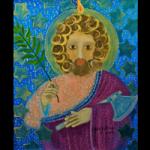
Painting: St. Jude Thaddeus by Maria Matheus


Maria Matheus, is an artist born in São Paulo, Brazil. She graduated in architecture, having worked as a designer at the Anos 50 Art Gallery. She participated in individual and group exhibitions, at cities like São Paulo, Santos, Brasilia and others.

Ending her work at Anos 50 Art Gallery, Maria Matheus returned to academy where she obtained her doctorate degree, devoting herself to teaching and research. The possibility of dividing her life between Paraty in Brazil and Bayfield in the U.S.A. led her back to fine arts. Her works signed as Maria Santeira reflect her theme option, having sacred as predominant theme.

Sunday, April 30, 2017

Why do people pray to St. Jude?


Source link here.

Catholics have a long tradition of praying to the saints and this tradition has sometimes been misunderstood. With all Christians we keep the First Commandment and adore only the Most Blessed Trinity. Praying to the saints is not a substitute for praying to God, whom we acknowledge to be the source of everything.

We pray to the saints because they are our older sisters and brothers who have gone through what we ourselves are experiencing now. We ask them to remind God that it was by His grace that they triumphed over life’s difficulties and that we today need that same grace.

Even though we have a long tradition of praying to the saints (or more precisely asking the saints to pray to the Lord our God for us!), it is only in our own times that St. Jude has become a popular patron. Why? In the past, people sometimes confused St. Jude with Judas Iscariot, but people now realize they are alike in name only!

And people realized too that the story of St. Jude is very often like their own: people sometimes ignored and misunderstood – people struggling to accept their call to holiness and the offer of forgiveness – people finding it hard to believe that God is always faithful to his promises.

If any of those phrases describe you, welcome!

Saturday, April 22, 2017

Article: Touching Incidents and Remarkable Answers to Prayer by S.B. Shaw


From “Touching Incidents and Remarkable Answers to Prayer” by S.B. Shaw, 1893 (source link here).

I had had a very busy day, and experienced a very delightful feeling of restfulness, as I settled myself in a comfortable arm-chair, after having said “Good-night” to my children. Just before going, they had sung their evening hymn. As their sweet childish voices had joined with that of their mother, one verse had made an impression on my mind.

I was familiar with it, but it came to me with a new beauty and force. It was:

Not a brief glance I beg, a passing word,
But as Thou dwell’st with Thy disciples, Lord
Familiar, condescending, patient, free,
Come not to sojourn, but abide with me.”

My wife went away with the little ones to see them to bed, and I was left alone with this verse of the hymn repeating itself in my memory; and the thought came to me, supposing He were to come as He came to his disciples, am I altogether prepared to receive Him into my house, to abide with me? And as I meditated on the subject, I fell asleep, and dreamed, and, lo the door of the room opened, and in walked one whom I knew at once to be the Christ. Not the glorified Redeemer, as seen by John in the Isle of Patmos. No, he had answered the prayer of our hymn, and had come in humble human form:
“Familiar, condescending, patient, free.”

I knelt before Him, but He laid His hand on me and said: “Arise, for I have come to tarry with thee.”

My recollection of my dream here grows somewhat confused; but I remember it again when the next morning seemed to have arrived, and I was gathering my children around me, and telling them that Jesus had come to stay with us in the house. The little ones clapped their hands for joy, and my dear wife’s face beamed with rapture that seemed to transfigure her.

Just then the Lord Himself entered the room, and we took our seats around the breakfast-tablet. What language can I use to describe the wondrous peace which filled all our souls, or how our hearts burned within us as He talked with us?

But when the meal was over, and we had family worship, which was that day a foretaste of heaven itself. I was ailed with perplexity. What should I do with my strange visitor? It seemed disrespectful to leave Him behind me at home yet it would mean serious loss to me to stay away from my place of business that day. But I could not take him with me, that was certain who ever heard of taking Christ to a counting-house?

The Savior surely knew my thoughts, for he said, “I will go with thee. How didst thou ask me? Was it not:
“Come not to sojourn, but abide with me?”

So whatever thou art doing, henceforth I will be beside thee. Lo, I am with you always, even unto the end of the world.”

It seemed rather strange to me, but I could not, of course, question what He said, so I started for my office with the dear Lord by my side.

At my counting-house I found a man waiting my coming with a good deal of impatience. He was a stock and share-broker, who transacted considerable business for me. To tell the, truth, I was not greatly pleased to see him there, as I was afraid that he might bring forward matters which I would not feel inclined to go into with Jesus listening to our conversation.

It was as I feared. He had come to tell me of a transaction he had arranged, which, whilst perfectly honorable according to the usual code of morals of the share-market, meant the saving of myself from the fear of loss by placing another person in the danger of it. He laid the whole scheme before me, without taking the slightest notice of the Lord; I knew not if he even saw Him.

I cannot tell the bitter shame I felt. I saw how impossible it was to square such a transaction with the Golden Rule; but I could not hide from myself the fact that the broker told me of it with a manner and tone that meant that he had no doubt whatever that I would applaud him for his cleverness, and eagerly close with the offer. What must that mean to the Christ? Would it not tell him that I was in the habit of dealing with one thought in my mind-how I could benefit myself?

The broker was astonished when I rejected his proposals, on the ground that they would be prejudicial to the interest of the other party in the transaction; and left me abruptly, apparently thinking I had developed a mild species of insanity.

Humbled, I fell at my Savior’s feet, and cried to Him for forgiveness for past sinfulness, and strength for time to come.

“My child,” said He, in tender accents, “thou speakest as if my presence were something strange to thee. But I have always been with thee. I have seen and seen with grief, the way thou hast dealt with thy fellows, in business, and marveled at thy unbelief of My promise that I would ever be with thee. Have I not said to my servants, Abide in Me, and I in thee?

Just as He said these words, another gentleman entered the office. He was a customer whom I could not afford to offend, and I had uniformly shown a cordiality to him which I was far from feeling in my heart. He was vulgar, profane, and often obscene in his talk.

He had not been many minutes in my office before he made use of an expression which brought a hot blush to my cheek. I had heard him speak in a similar way before; and, although I felt repelled by it, I had, for fear of offending him, met it with faint laughter. But now I felt as I should have had it been uttered in the presence of a lady; only this feeling was intensified by the realization of the absolute purity of the Divine One who had been a hearer of the speech.

I gave expression to my feeling in a word of expostulation , and he exclaimed: “You seem to have suddenly grown very prudish,” and left me in a rage.

Again, I turned to the Christ with a cry for pardon; and again, I learned that he had beheld all my former intercourse with this man.

I was now called into the adjoining office, where my clerks were employed, and found that one of them had made a foolish blunder, which would mean a considerable complication, and perhaps loss. I am naturally irritable, and at once lost my temper, and spoke to the delinquent in unmeasured terms. Turning my head, I saw that Jesus had followed me out of my private office, and was standing close beside me.

Again I was humbled, and had to cry for mercy.

Through all that strange day, similar incidents occurred; and the presence of the Master, which I thought would have been a joy, was a rebuke to me. It showed me, as I had never dreamed before, that I had framed my life on the supposition that He had but little to do with it.

But, on the other hand, there were times during the day when my soul was filled with rapture; times when He smiled on me in loving approval, or when He spoke words of pardon and absolution, or when He opened out before my wondering gaze some fresh beauty of His character and person. Such a time was the moment when, on my return to my home, the children came crowding around Him, and wanted to show Him their toys and pigeons, and a brood of newly-hatched chickens, and I rebuked them, and said to them “Run away, children! Trouble not the Master with such trifles.”

And he seated himself and took my curly-headed little boy on His knee, and called my two little girls to His side, and said to me: “Suffer these little children to come unto me, and forbid them not; for of such is the kingdom of heaven.”

I awoke, and lo! It was a dream. — The Ballarat Christian Union.

Sunday, February 26, 2017

Blog Post: When You Can't Pray


From Striving for 31 by Amber (source link here).

Romans 8:26-27
"And the Holy Spirit helps us in our weakness. For example, we don’t know what God wants us to pray for. But the Holy Spirit prays for us with groanings that cannot be expressed in words. And the Father who knows all hearts knows what the Spirit is saying, for the Spirit pleads for us believers in harmony with God’s own will."

Have you ever been to the point where you just couldn't pray anymore? Have you tried a million times to petition the Father, only to feel your mind floating into paralysis as no words seem adequate?

I'm there.

A few weeks ago, a precious friend of mine told me she was in that place. She said, "I just can't pray anymore. I can pray for others, but not for myself."

Despite her inability to verbalize her heart, God saw her. And He answered her in a marvelous way this very day. Praise God!

I think God allowed me to stand witness to her journey to encourage me out of my own pit. I have reached the point where I can't seem to pray. Don't get me wrong... I try... a lot. I start to pray. Sometimes I get words out. Sometimes I make sense in my prayers. But most of the time, the darkness and confusion just chokes the words right out of my mouth. Girls, I've gotta confess... I'm in a pit.

I'm not depressed. I'm not having a nervous breakdown. I'm just walking through a spiritual wilderness. Nothing seems certain and I feel very alone. Satan has worked overtime around here and I'm struggling to get through it.

Why do I share this? I want to ask you to pray when I can't. Many of you are pastor's wives and you know the struggle I'm speaking of. The out-of-control, desperate feeling where you have no voice in the direction your life will take. The longing for God's will more than breath. The deep love for your man when he is so defeated that he can't see outside his own discouragement. The moment when you realize you've been in the pit for so long, that you don't know how to get out.

Girls, please pray for deliverance. Please pray for Josh. Please pray for me.

I take comfort in knowing that the Holy Spirit is interceeding for us, according to God's perfect will which seems so impossible to discern. I absolutely believe that God has brought this about for a purpose. I believe He is refining us. I believe He is tugging at the most uncomfortable places in my heart, requiring surrender, requiring everything.

He is good. I will never sway from that. I don't question His goodness or His plan. I just question my inability to make heads or tails out of anything anymore.

Please pray that I will thirst for His Word and that it will bring new life to my soul.

I am sending my children to stay with their grandparents tonight. I originally intended to work. But instead, I believe I am going to sit before the Lord, for as long as it takes, to see Him. To feel Him. And to be able to talk with Him again.

We're going to get through this and have such an amazing story to share in the end. I just pray that we're in the final paragraphs of this chapter in our lives.

Until Tomorrow,
Amber

Sunday, February 5, 2017

Painting: Saint Thadée (or Saint Jude) by James Tissot

James Jacques Joseph Tissot (October 15, 1836 – August 8, 1902) was a French painter. Tissot was born at Nantes. He studied at the École des Beaux-Arts in Paris under Ingres, Flandrin and Lamothe, and exhibited in the Paris Salon for the first time at the age of twenty-three.

Sunday, January 29, 2017

Article: Burden to Pray


A web article from BibleHelp.org (source link here)...

"You better call home because you wife and kids are dead!" a large prisoner said with a glazed look in his eyes. My Sergeant, who was stunned by the announcement, rose slowly to protect himself from this strange acting prisoner. Suddenly, the prisoner attacked him with a desk lamp. My natural response was to jump on the prisoner’s back to help subdue him. In the violent struggle, my back was gouged by a piece of metal, which caused a 2" x 10" cut. After the prisoner was subdued, I was taken to the hospital for treatment.

This incident happened during my fourth week of working in the prison. Being a Correction Officer is difficult enough as it is, but it is even more difficult for new officers. Since new officers were rare before the massive prison buildup in the mid-1980s, the prisoners had more time to test the new officers to see if they could be intimidated. Unfortunately, this testing often lasted for months.

Since I was getting tired of this testing, I was hoping something unusual would happen that would cause the prisoners to respect me. In fact, the morning of the attack, I made such a prayer request. Of course, I was thinking of something a little less violent, such as making a major drug bust. As it turned out, I got the prisoner's attention by coming to the aid of the Sergeant. Word spread quickly in the prison, "… don’t mess with the new cop. He’s not afraid to fight." As a result, all of the prisoners left me alone.

In reality, my help in the fight had nothing to do with my being brave. It was simply a natural reaction. It happened so quickly I didn’t have time to be scared. If I'd had a couple of minutes to think about it beforehand, I would have been scared to be in a fight inside a prison surrounded by several hundred prisoners. Nevertheless, I didn’t bother explaining this to the prisoners. If they wanted to believe I was a fearless cop, who was I to correct them?

I have found it a little bit unnerving that the only day I prayed for this was the day the fight took place. Personally, I feel God put this prayer request in my heart because He wanted to do a special work in my life. I have found God often prompts people to pray when He is doing a unique task.

One day as I was driving down the highway, I decided to pray for a while. One of the things I prayed for was protection from getting a speeding ticket. This really surprised me because I had never prayed for that before, or since. There are two reasons I wouldn’t normally pray for something like this. First, if I am driving the speed limit there isn’t much risk of getting a ticket. Second, if I am deliberately speeding and I have the audacity to ask God to protect me while I break the law, my prayers may prompt Him to cause me to get a ticket. Since I try to adhere to the speed limit, I really couldn’t understand why I would even consider such a prayer. It just came out.

However, a couple minutes later I reached over in the car to pick up something from the floor and my foot pushed the gas pedal down. As I straightened up, I saw I was going 80 mph in a 55-mph zone. Also, at the same moment, I saw a State Police car in the median. He, of course, pulled out onto the highway and began to follow me. After three grueling miles, he stopped following me. I believe God foresaw what was going to happen and put that prayer request in my heart.

The salvation of the great missionary to China, Hudson Taylor, is another example of God’s prompting. Hudson became a Christian while his mom was away on a trip. Wanting to surprise his mom, he instructed everyone in his family to keep quiet about his experience. However, when he approached her about the good news, she said she already knew what he was going to say. She said, "You became a Christian about two weeks ago, didn’t you?" She even knew the exact day and time.

On the day he became a Christian, his mom had a tremendous burden for him, so she got out of her bed and started to pray for him. Although it seemed like a short period of time, her prayer session lasted several hours. When she was finished, she had such joy. She knew God had answered her prayers.

Another example of God prompting someone to pray is the salvation of a girl named Beth. I discussed this incident elsewhere in this book, but I feel it is important to include this example here. During a church service, I suddenly had a strong burden to pray for the salvation of a lifeguard (Beth) who happened to be attending the service. After praying for her, I wrote the phrase, "God, please save Beth" on a piece of paper. After the service she came up to me and told me she had become a Christian. Of course, she was very surprised to see the note I had written to God.

This prompting of God is quite common and a person could fill several large books with examples. Yet, I think it is natural to ask, "Why does God do this. Does He need our prayers? If God were all-powerful and all knowing, why would He need to prompt someone to pray in order to carry out His desired task?" Quite frankly, I don’t know. There are many things I don’t understand about prayer and our all-powerful God. I do know, however, God desires our prayers and is pleased when we put our full reliance on Him. Maybe the reason He occasionally reveals these unique promptings to us, is to reveal His power and bring us closer to His presence.

Sunday, December 18, 2016

Sermon: Practically Praying: Why Pray?

A sermon by Rev D. Graham Leitch of Barclay Church, Edinburgh, Scotland given January 26, 2003 (source link here).

“Why Pray?” - that’s the question that claims our attention and we’re invited to ponder this morning. Although this is meant to be very much a “how to” series - aimed at guiding and assisting those who want to begin praying or to be better pray-ers to progress - I make no apology for the fact that today’s sermon will be less of a “how to” sermon than the others!!

The motives behind the question “Why pray?” can vary.

MOTIVES BEHIND THE QUESTION ‘WHY PRAY?’
For the person of a more philosophical bent, the question may proceed from an inquiring mind:
In respect of prayer and intercession, “If God already knows all about our needs before we tell him, why bother?” In respect of praise and worship, “If God wants to be praised and thanked and fussed over continually does that not make him proud and self-centred.”

On the other hand, for the young widow standing beside her young husband’s grave - the husband for whose healing and recovery she has prayed and pleaded, begged, for the whole year since the traumatic day when the diagnosis and prognosis of his cancer was explained to him, the words “Why pray?” are no longer academic but mean “Why bother?!!”

I make no apology for this being less of a “how to” sermon than the others, because all the practical tips, guidance and advice in the world will be worthless to you unless you know the reason why PRAYER shouldn’t be the peculiar interest of a few enthusiasts but the perpetual practice of the entire church!

WHY PRAY? is our subject this morning.

Notice, by the way, that the answers to the question “Why SHOULD we pray?” may be different from the answers to the question “Why DO we pray?

WHY SHOULD WE PRAY AND WHY DO WE PRAY?
* Some people pray because they were taught to as children. There is something deeply moving about a child’s prayer.

A A MILNE - VESPERS
Little boy kneels at the foot of the bed,
Droops on the little hands little gold head,
Hush! Hush! Whisper who dares!
Christopher Robin is saying his prayers.

God bless mummy. I know that’s right.
Wasn’t it fun in the bath tonight?
The cold’s so cold and the hot’s so hot,
Oh! God bless Daddy - I quite forgot

If I open my fingers a little bit more,
I can see Nanny’s dressing gown on the door.
It’s a beautiful blue but it hasn’t a hood.
Oh! God bless Nanny and make her good!

Oh! Thank you God for a lovely day.
And what was the other I had to say
” I said ‘God bless Daddy’ so who can it be?
Oh! Now I remember - GOD BLESS ME!

* Some people pray because they were taught to as children.

* Some people pray because (though they’re not even sure of God, it makes them feel better, or because something in them tells them they should!

* And many an atheist has prayed to the God he denies when the going’s been tough or the situation’s been desperate or hopeless!

I’m not asking you to to think about why people DO pray but about why everyone SHOULD PRAY

I want to give you four answers - and I’ll tell you WHAT they are now so that you can follow more clearly and at the same time not become over anxious about how long the sermons going to be!!

WHY SHOULD WE PRAY?

We should pray, first,because of WHO we are. We should pray, second, because of WHAT we are.
Third, we should pray because of who GOD is. And finally, we should pray because of what PRAYER itself is.

1. WE SHOULD PRAY BECAUSE OF WHO WE ARE
WHY PRAY? We should pray because of who we are. Some of you will know the story of the Minister who visited one of his older member who was in residential care - she has become rather confused and forgetful and so to test whether she really knew him or not he gently sat beside her, took her hand and asked her “Now - who am I?’ to which nodding in a kindly and understanding way she replied:
“Don’t worry son, lots of folk forget who they are in her - but if you ask that lady over there, she one of the care staff and she’ll tell you who you are - and perhaps” she added smiling, “you’ll be able to remember!”

We should pray because of who we are!! One of the reasons why we don’t pray is that we’ve forgotten who we are!!

We remember that “no man is an island” - we know that we were not made to live in isolation - but in our preoccupation with human relations and culture’s encouragement to live this life to the full we have forgotten that we were not only made by God but are made FOR relationship with Him - to know Him and enjoy Him.

OUTSIDE OF GOD WE ARE INCOMPLETE
In God we find our fulfilment and satisfaction, but outside of God we are incomplete. We should pray because of who we are ! We are part of the animal creation, but we are unique within it, being made, the Bible tells us, “in the image of God” Alone, within the animal creation, we have the capacity of knowing God and relating to Him.... and this is not an “extra” - the “icing on the cake”, so to speak. It the supreme purpose of our lives.... but it is also, or it is intended to be, the essence of our lives - its what we’re made for!!

Now Springtime’s coming and before long the spring flower will be braking through the ground to greet the returning warmth of the New Year’s sun. But what happens if a bulb’s planted upside down....if it produces a flower at all it produce one that is stunted and weak - it may still be a snowdrop or daffodil. But it is isn’t half the snowdrop of daffodil it would have been if it had been the right way up!!

We cannot be complete without prayer because we cannot be completely human - complete persons - without God. A life that neglects its spiritual nature is like a bulb planted upside down!!

WHY PRAY? We should pray because of who we are. Individuals made for relationship with God.

2. WE SHOULD PRAY BECAUSE OF WHAT WE ARE
We should PRAY also because of WHAT we are. All of us are different - every single one of us - but none of us, not a single one of us is all we should be!!

Our weakness are many are varied - in this we are all different. What is not a temptation to one person may be a great temptation to another. To steal, to thieve, to commit adultery, to lie, to abuse the body or the body of another, to be callous cruel or violent.

The spiritual DNA of every person is different, but in this we are identical and equal- that we are at fault, guilty, we’re not perfect. We’re “damaged goods”, if you like........we have ignored God,, despised His will and disobeyed His commands.

i) We should pray because of WHO we are - each one and every one of us is made for relationship with God.

ii) We should PRAY also because of WHAT we are - SINNERS! Sin is simply falling short of God’s perfect standard. A miss, here is as good as a mile!! Who today dare stand before God and claim to be as good a father, mother, son, daughter, colleague or friend to others as we could have been.

Who amongst us can claim no regret. Aren’t there things you wish you’d done differently - things you wish had never happened. Things you know you’ve done wrong!! Are you the only one who’s never said “If only.....”?

JOHN 8:1-12
Remember that heart stopping drama pictured by John in Chapter 8 of His Gospel when the self-righteous Pharisees bundles a women caught being unfaithful to her husband before Him. And they sneered and pointed their fingers and poked her:

“The Bible says that women of her kind should be stoned!!” they urged.

But Jesus, looked at one and then another - and it was a s though his gaze read their inmost hearts and unravelled their darkest secrets :Let the person without sin throw the first stone!” And one by one they left!

Since the days of Adam there has only been one Person without sin - and that Person was Jesus Christ Himself. He alone was “without sin”

Prayer is therefore not an irrelevance for us; it is a necessity for us, for prayer is the hand of faith reaching out to accept God;’ offered forgiveness. All true prayers begins with this:

“God be merciful to me, a sinner!”

WHY SHOULD WE PRAY?
We should pray, first,because of WHO we are - persons made in the image of God to know Him - this is the language of intimacy, even of intercourse. We were made for God!!

We should pray, second, because of WHAT we are - people who have let others down and let God down People who need, though we can never deserve His forgiveness.

3. WE SHOULD PRAY BECAUSE OF WHO GOD IS!
We should pray, third, because of who GOD is!! He is the all powerful, all wise, all knowing, all holy, all merciful, all loving One - perfect in His nature, His being and all His actions. He is the supreme, preeminent One. We should pray because of WHO God is - we should praise Him because He expects and commands our praise.

Of course, this may seem strange - unchristian almost!! If God wants us to praise Him all the time is He not proud and self-centred. Someone who wants to be praised and thanked all day long is unattractive to us...

But it is not for any selfishness in HIM that God wants us to praise Him, but to deliver us from the self-centredness that’s in US!!

We should praise God for who He is, because praise and worship is the natural thing, once we know how much we owe Him and how great His love for us, for us to do!

A passage in C S Lewis’s book “Reflections on the Psalms” offers a profound insight into the nature of prayers of praise and worship offered to God:
C S. LEWIS
“I had never noticed” he writes “that all enjoyment spontaneously overflows into praise unless (sometimes even if) shyness or the fear of boring others i deliberately brought in to check it. The world rings with praise - lovers praising their mistresses, readers their favourite poet, walkers praising the countryside, players praising their favourite game - praise of weather, wines, dishes, actors, motors, horses, colleges countries, historical figures, children, flowers, mountains, rare stamps, rare beetles, sometimes even politicians or scholars.

I has not noticed how the humblest and most capacious minds praised most... I had not noticed, either, that just as persons spontaneously praise what they value, so they spontaneously urge us to join them in praising it: ‘Isn’t she lovely?! Wasn’t it glorious?!! Don’t you think that’s magnificent?!!

The Psalmists, in telling everyone to praise God, are doing what we all do when we speak of what we care about!”

Why should we pray? Do lovers never talk together?

Why should we PRAY - we should pray because of who GOD is - as children we were taught to say thank you - “What do you say to the lady? And at first, perhaps we recoiled with embarrassment and shyly hid behind mummy’s legs!! But we learned to say thank you - not just to be courteous and polite but to be be appreciative and grateful.

As children we we’re taught to say thank. As parents, in turn, we have taught our children to say “Thank You “ and they are teaching their children to say thank you!

Peter’s thank-you letter.
Many of you know we have three grandchildren - Peter, Anna and Matthew. On Friday - just a couple of days ago - I received a Christmas “thank you” letter from Peter, who’s four:
Dear Grandma and Grandpa (it read)
This is grandpa watching a scarey programme. Thank for my spaceship but some of it is broken....but I like spaceships.
Love from Peter.

How much more then, do we owe thanks to God for life, for all that makes us happy and for His Son?

WHY SHOULD WE PRAY?

3. WE SHOULD PRAY BECAUSE OF WHO GOD IS!
Finally, and briefly, we should pray because of what PRAYER IS

In relation to WHO WE ARE - it is the means by which we may enter into a relationship with God through Jesus Christ - and then it is the enjoyment and deepening of that relationship. It is the relationship of the loved to the Great Lover. - intimate and sublime - a love affair with God!!

In relation to WHAT WE ARE - it is the means by which through Jesus Christ we access God’s heart and daily find His pardon.

And in relation to WHO HE IS - it is the key to the door that leads weakness to the help of Divine Omnipotence, worry to the feet of the All wise God, and loneliness to the heart of an Everlasting Friend.

To refuse prayer - is to walk away from the most immensely satisfying and enriching relationship possible to any individual.

To refuse prayer is to withhold thanks from the Author of Life and giver of every good gift.

And to refuse prayer is to reject the only Hand that, in the worst of times, can still lift us up.
AMEN

Sunday, December 22, 2013

Why do people pray to St. Jude?


Source link here.

Catholics have a long tradition of praying to the saints and this tradition has sometimes been misunderstood. With all Christians we keep the First Commandment and adore only the Most Blessed Trinity. Praying to the saints is not a substitute for praying to God, whom we acknowledge to be the source of everything.

We pray to the saints because they are our older sisters and brothers who have gone through what we ourselves are experiencing now. We ask them to remind God that it was by His grace that they triumphed over life’s difficulties and that we today need that same grace.

Even though we have a long tradition of praying to the saints (or more precisely asking the saints to pray to the Lord our God for us!), it is only in our own times that St. Jude has become a popular patron. Why? In the past, people sometimes confused St. Jude with Judas Iscariot, but people now realize they are alike in name only!

And people realized too that the story of St. Jude is very often like their own: people sometimes ignored and misunderstood – people struggling to accept their call to holiness and the offer of forgiveness – people finding it hard to believe that God is always faithful to his promises.

If any of those phrases describe you, welcome!

Sunday, October 7, 2012

Question: Why Pray?


Source link here.

Question: "Why pray? What is the point of prayer when God knows the future and is already in control of everything. If we cannot change God's mind, why should we pray?"

Answer: For the Christian, praying is like breathing. It is easier to do it than to not do it. We pray for a variety of reasons. For one thing, prayer is a form of serving God (Luke 2:36-38) and obeying Him. We pray because God commands us to pray (Philippians 4:6-7). Prayer is exemplified for us by Christ and the early church (Mark 1:35; Acts 1:14; 2:42; 3:1; 4:23-31; 6:4; 13:1-3). If Jesus thought it was worthwhile to pray, we should also. If He needed to pray to remain in the Father’s will, how much more do we need to pray?

Another reason to pray is that God intends prayer to be the means of obtaining His solutions in a number of situations. We pray in preparation for major decisions (Luke 6:12-13); to overcome demonic barriers (Matthew 17:14-21); to gather workers for the spiritual harvest (Luke 10:2); to gain strength to overcome temptation (Matthew 26:41); and to obtain the means of strengthening others spiritually (Ephesians 6:18-19).

We come to God with our specific requests, and we have God's promise that our prayers are not in vain, even if we do not receive specifically what we asked for (Matthew 6:6; Romans 8:26-27). He has promised that when we ask for things that are in accordance with His will, He will give us what we ask for (1 John 5:14-15). Sometimes He delays His answers according to His wisdom and for our benefit. In these situations, we are to be diligent and persistent in prayer (Matthew 7:7; Luke 18:1-8). Prayer should not be seen as our means of getting God to do our will on earth, but rather as a means of getting God's will done on earth. God’s wisdom far exceeds our own.

For situations in which we do not know God's will specifically, prayer is a means of discerning His will. If the Syrian woman with the demon-influenced daughter had not prayed to Christ, her daughter would not have been made whole (Mark 7:26-30). If the blind man outside Jericho had not called out to Christ, he would have remained blind (Luke 18:35-43). God has said that we often go without because we do not ask (James 4:2). In one sense, prayer is like sharing the gospel with people. We do not know who will respond to the message of the gospel until we share it. In the same way, we will never see the results of answered prayer unless we pray.

A lack of prayer demonstrates a lack of faith and a lack of trust in God’s Word. We pray to demonstrate our faith in God, that He will do as He has promised in His Word and bless our lives abundantly more than we could ask or hope for (Ephesians 3:20). Prayer is our primary means of seeing God work in others' lives. Because it is our means of “plugging into” God's power, it is our means of defeating Satan and his army that we are powerless to overcome by ourselves. Therefore, may God find us often before His throne, for we have a high priest in heaven who can identify with all that we go through (Hebrews 4:15-16). We have His promise that the fervent prayer of a righteous man accomplishes much (James 5:16-18). May God glorify His name in our lives as we believe in Him enough to come to Him often in prayer.

Sunday, September 16, 2012

Sermon: Practically Praying: Why Pray?

A sermon by Rev D. Graham Leitch of Barclay Church, Edinburgh, Scotland given January 26, 2003 (source link here).

“Why Pray?” - that’s the question that claims our attention and we’re invited to ponder this morning. Although this is meant to be very much a “how to” series - aimed at guiding and assisting those who want to begin praying or to be better pray-ers to progress - I make no apology for the fact that today’s sermon will be less of a “how to” sermon than the others!!

The motives behind the question “Why pray?” can vary.

MOTIVES BEHIND THE QUESTION ‘WHY PRAY?’
For the person of a more philosophical bent, the question may proceed from an inquiring mind:
In respect of prayer and intercession, “If God already knows all about our needs before we tell him, why bother?” In respect of praise and worship, “If God wants to be praised and thanked and fussed over continually does that not make him proud and self-centred.”

On the other hand, for the young widow standing beside her young husband’s grave - the husband for whose healing and recovery she has prayed and pleaded, begged, for the whole year since the traumatic day when the diagnosis and prognosis of his cancer was explained to him, the words “Why pray?” are no longer academic but mean “Why bother?!!”

I make no apology for this being less of a “how to” sermon than the others, because all the practical tips, guidance and advice in the world will be worthless to you unless you know the reason why PRAYER shouldn’t be the peculiar interest of a few enthusiasts but the perpetual practice of the entire church!

WHY PRAY? is our subject this morning.

Notice, by the way, that the answers to the question “Why SHOULD we pray?” may be different from the answers to the question “Why DO we pray?

WHY SHOULD WE PRAY AND WHY DO WE PRAY?
* Some people pray because they were taught to as children. There is something deeply moving about a child’s prayer.

A A MILNE - VESPERS
Little boy kneels at the foot of the bed,
Droops on the little hands little gold head,
Hush! Hush! Whisper who dares!
Christopher Robin is saying his prayers.

God bless mummy. I know that’s right.
Wasn’t it fun in the bath tonight?
The cold’s so cold and the hot’s so hot,
Oh! God bless Daddy - I quite forgot

If I open my fingers a little bit more,
I can see Nanny’s dressing gown on the door.
It’s a beautiful blue but it hasn’t a hood.
Oh! God bless Nanny and make her good!

Oh! Thank you God for a lovely day.
And what was the other I had to say
” I said ‘God bless Daddy’ so who can it be?
Oh! Now I remember - GOD BLESS ME!

* Some people pray because they were taught to as children.

* Some people pray because (though they’re not even sure of God, it makes them feel better, or because something in them tells them they should!

* And many an atheist has prayed to the God he denies when the going’s been tough or the situation’s been desperate or hopeless!

I’m not asking you to to think about why people DO pray but about why everyone SHOULD PRAY

I want to give you four answers - and I’ll tell you WHAT they are now so that you can follow more clearly and at the same time not become over anxious about how long the sermons going to be!!

WHY SHOULD WE PRAY?

We should pray, first,because of WHO we are. We should pray, second, because of WHAT we are.
Third, we should pray because of who GOD is. And finally, we should pray because of what PRAYER itself is.

1. WE SHOULD PRAY BECAUSE OF WHO WE ARE
WHY PRAY? We should pray because of who we are. Some of you will know the story of the Minister who visited one of his older member who was in residential care - she has become rather confused and forgetful and so to test whether she really knew him or not he gently sat beside her, took her hand and asked her “Now - who am I?’ to which nodding in a kindly and understanding way she replied:
“Don’t worry son, lots of folk forget who they are in her - but if you ask that lady over there, she one of the care staff and she’ll tell you who you are - and perhaps” she added smiling, “you’ll be able to remember!”

We should pray because of who we are!! One of the reasons why we don’t pray is that we’ve forgotten who we are!!

We remember that “no man is an island” - we know that we were not made to live in isolation - but in our preoccupation with human relations and culture’s encouragement to live this life to the full we have forgotten that we were not only made by God but are made FOR relationship with Him - to know Him and enjoy Him.

OUTSIDE OF GOD WE ARE INCOMPLETE
In God we find our fulfilment and satisfaction, but outside of God we are incomplete. We should pray because of who we are ! We are part of the animal creation, but we are unique within it, being made, the Bible tells us, “in the image of God” Alone, within the animal creation, we have the capacity of knowing God and relating to Him.... and this is not an “extra” - the “icing on the cake”, so to speak. It the supreme purpose of our lives.... but it is also, or it is intended to be, the essence of our lives - its what we’re made for!!

Now Springtime’s coming and before long the spring flower will be braking through the ground to greet the returning warmth of the New Year’s sun. But what happens if a bulb’s planted upside down....if it produces a flower at all it produce one that is stunted and weak - it may still be a snowdrop or daffodil. But it is isn’t half the snowdrop of daffodil it would have been if it had been the right way up!!

We cannot be complete without prayer because we cannot be completely human - complete persons - without God. A life that neglects its spiritual nature is like a bulb planted upside down!!

WHY PRAY? We should pray because of who we are. Individuals made for relationship with God.

2. WE SHOULD PRAY BECAUSE OF WHAT WE ARE
We should PRAY also because of WHAT we are. All of us are different - every single one of us - but none of us, not a single one of us is all we should be!!

Our weakness are many are varied - in this we are all different. What is not a temptation to one person may be a great temptation to another. To steal, to thieve, to commit adultery, to lie, to abuse the body or the body of another, to be callous cruel or violent.

The spiritual DNA of every person is different, but in this we are identical and equal- that we are at fault, guilty, we’re not perfect. We’re “damaged goods”, if you like........we have ignored God,, despised His will and disobeyed His commands.

i) We should pray because of WHO we are - each one and every one of us is made for relationship with God.

ii) We should PRAY also because of WHAT we are - SINNERS! Sin is simply falling short of God’s perfect standard. A miss, here is as good as a mile!! Who today dare stand before God and claim to be as good a father, mother, son, daughter, colleague or friend to others as we could have been.

Who amongst us can claim no regret. Aren’t there things you wish you’d done differently - things you wish had never happened. Things you know you’ve done wrong!! Are you the only one who’s never said “If only.....”?

JOHN 8:1-12
Remember that heart stopping drama pictured by John in Chapter 8 of His Gospel when the self-righteous Pharisees bundles a women caught being unfaithful to her husband before Him. And they sneered and pointed their fingers and poked her:

“The Bible says that women of her kind should be stoned!!” they urged.

But Jesus, looked at one and then another - and it was a s though his gaze read their inmost hearts and unravelled their darkest secrets :Let the person without sin throw the first stone!” And one by one they left!

Since the days of Adam there has only been one Person without sin - and that Person was Jesus Christ Himself. He alone was “without sin”

Prayer is therefore not an irrelevance for us; it is a necessity for us, for prayer is the hand of faith reaching out to accept God;’ offered forgiveness. All true prayers begins with this:

“God be merciful to me, a sinner!”

WHY SHOULD WE PRAY?
We should pray, first,because of WHO we are - persons made in the image of God to know Him - this is the language of intimacy, even of intercourse. We were made for God!!

We should pray, second, because of WHAT we are - people who have let others down and let God down People who need, though we can never deserve His forgiveness.

3. WE SHOULD PRAY BECAUSE OF WHO GOD IS!
We should pray, third, because of who GOD is!! He is the all powerful, all wise, all knowing, all holy, all merciful, all loving One - perfect in His nature, His being and all His actions. He is the supreme, preeminent One. We should pray because of WHO God is - we should praise Him because He expects and commands our praise.

Of course, this may seem strange - unchristian almost!! If God wants us to praise Him all the time is He not proud and self-centred. Someone who wants to be praised and thanked all day long is unattractive to us...

But it is not for any selfishness in HIM that God wants us to praise Him, but to deliver us from the self-centredness that’s in US!!

We should praise God for who He is, because praise and worship is the natural thing, once we know how much we owe Him and how great His love for us, for us to do!

A passage in C S Lewis’s book “Reflections on the Psalms” offers a profound insight into the nature of prayers of praise and worship offered to God:
C S. LEWIS
“I had never noticed” he writes “that all enjoyment spontaneously overflows into praise unless (sometimes even if) shyness or the fear of boring others i deliberately brought in to check it. The world rings with praise - lovers praising their mistresses, readers their favourite poet, walkers praising the countryside, players praising their favourite game - praise of weather, wines, dishes, actors, motors, horses, colleges countries, historical figures, children, flowers, mountains, rare stamps, rare beetles, sometimes even politicians or scholars.

I has not noticed how the humblest and most capacious minds praised most... I had not noticed, either, that just as persons spontaneously praise what they value, so they spontaneously urge us to join them in praising it: ‘Isn’t she lovely?! Wasn’t it glorious?!! Don’t you think that’s magnificent?!!

The Psalmists, in telling everyone to praise God, are doing what we all do when we speak of what we care about!”

Why should we pray? Do lovers never talk together?

Why should we PRAY - we should pray because of who GOD is - as children we were taught to say thank you - “What do you say to the lady? And at first, perhaps we recoiled with embarrassment and shyly hid behind mummy’s legs!! But we learned to say thank you - not just to be courteous and polite but to be be appreciative and grateful.

As children we we’re taught to say thank. As parents, in turn, we have taught our children to say “Thank You “ and they are teaching their children to say thank you!

Peter’s thank-you letter.
Many of you know we have three grandchildren - Peter, Anna and Matthew. On Friday - just a couple of days ago - I received a Christmas “thank you” letter from Peter, who’s four:
Dear Grandma and Grandpa (it read)
This is grandpa watching a scarey programme. Thank for my spaceship but some of it is broken....but I like spaceships.
Love from Peter.

How much more then, do we owe thanks to God for life, for all that makes us happy and for His Son?

WHY SHOULD WE PRAY?

3. WE SHOULD PRAY BECAUSE OF WHO GOD IS!
Finally, and briefly, we should pray because of what PRAYER IS

In relation to WHO WE ARE - it is the means by which we may enter into a relationship with God through Jesus Christ - and then it is the enjoyment and deepening of that relationship. It is the relationship of the loved to the Great Lover. - intimate and sublime - a love affair with God!!

In relation to WHAT WE ARE - it is the means by which through Jesus Christ we access God’s heart and daily find His pardon.

And in relation to WHO HE IS - it is the key to the door that leads weakness to the help of Divine Omnipotence, worry to the feet of the All wise God, and loneliness to the heart of an Everlasting Friend.

To refuse prayer - is to walk away from the most immensely satisfying and enriching relationship possible to any individual.

To refuse prayer is to withhold thanks from the Author of Life and giver of every good gift.

And to refuse prayer is to reject the only Hand that, in the worst of times, can still lift us up.
AMEN

Sunday, September 9, 2012

Spread the word about the St. Jude novena blog


Thank you for visiting and supporting the St. Jude novena blog. Since establishing the blog in late November (2008), we receive more than 1,200 first-time and returning (unique) visitors each month. Let your family and friends know about this site. We do not advocate spamming people; however, our success at spreading the word about St. Jude and his faith-based power to help us in times of need and desperation can only be achieved with your assistance.

Please let people know of the blog's URL (http://stjudenovenablog.blogspot.com/).

God bless.

Sunday, August 26, 2012

If God is Sovereign, Why Pray?

A sermon by Dr. Ray Pritchard of Keep Believing Ministries given January 1998 (source link here).

When we surveyed the congregation last year several people asked this question. I would suppose that most Christians have wondered about it at one time or another. Certainly skeptics have thrown it in our faces to discourage us from seeking the Lord in times of crisis. I would be less than honest if I didn’t say that I myself have wrestled with this issue on more than one occasion.

Perhaps the place to begin is by sketching the question in more detail. Here are five statements that I believe we can all agree on:

1. God knows all things. We call this aspect of God’s character his omniscience. It speaks to the fact that because God is God, he knows all things that could be known-past, present, and future-and he knows them all at the same time. That means that God is never surprised and that he never learns anything new.

2. God has committed himself to provide for his people. In fact, I think we can state the position even more forcefully than that. God wants to provide for us, he intends to provide for us, and he will provide what we need. In Philippians 4:19 Paul assures us that “God will meet all your needs,” which is the New Testament version of Psalm 23:1, “The LORD is my shepherd, I shall not want.” David also said in Psalm 34:9, “Fear the LORD, you his saints, for those who fear him lack nothing.” God promises that “I will refresh the weary and satisfy the faint” (Jeremiah 31:25). When we pray “Give us this day our daily bread,” do we not pray to a God who has promised to give us all the bread we need precisely when we need it? The whole record of the Bible teaches us that God is the Great Provider, which is why one of his divine names is Jehovah Jireh-“The LORD will provide” (Genesis 22:14).

3. God has invited us to bring our needs to him. We are told to ask, to seek, to knock (Matthew 7:7-8). Why? Ask and it shall be given, seek and you will find, knock and the door will be opened unto you. In Psalm 81:10 the Lord promises, “Open wide your mouth and I will fill it.” This is where prayer becomes intensely personal. Our Heavenly Father-who already knows our needs-invites us to make our needs known through prayer.

4. We don’t know what we really need. We think we do, but we don’t. Or to be more accurate, we know part of our needs, but not all of them. Our perspective is inevitably limited by our own experience, desires and personal knowledge. Romans 8:26 says that “We do not know what we ought to pray for.” How true that is. Recently I was presented with a problem involving a couple whose marriage has been in a crisis situation for many years. I can honestly say that I have prayed so much for this couple without a positive result that when I try to pray now, I don’t know how to pray for them effectively. That’s why the most basic prayer is always “Thy will be done.” But God knew that we would often be baffled in prayer so he sent the Holy Spirit who intercedes for us. He prays for us when we don’t know how to pray for ourselves or for anyone else.

5. God knows what we need before we ask him. Matthew 6:8 says this very plainly: “Your Father knows what you need before you ask him.” That means we don’t have to impress God, use big words, or pray long prayers. We don’t have to repeat ourselves when we pray and worry about getting all the details correct or throw in flowery language when we pray. Since God knows us through and through, he knows our needs better than we do. When you pray, you aren’t informing God of anything. He knew your need before you bowed your head.

But that brings us back to the original question. If God knows everything before we pray, and if he truly wants to provide for us anyway, why bother praying at all? Isn’t prayer just a waste of time? Or you might say it this way: If God has ordained all things, won’t he do whatever he’s going to do, with or without my prayers?

With that as background, I’d like to consider four answers to the question, If God is sovereign, why pray?

1. We do not pray to inform God of anything.
This may be obvious but it needs to be stated anyway. When you pray, you aren’t informing God of things he wouldn’t otherwise know. The Bible tells us that he numbers the stars in the sky, the sand on the seashore, and the hairs on your head. He even calls the stars by name (Psalm 147:4). Ponder that for a moment. Billions and billions of stars and he knows the personal name of each one. Think how easily you get flustered on Sunday morning trying to remember that person you met last week. I’m sure there is no one in our church-including me-who knows the names of everyone who attends our three services each Sunday morning.

But God does. He not only knows all the people in this church, he knows everyone attending every church everywhere in the world today. More than that, he knows the names of all 5.7 billion people who call planet earth home. But even beyond that, he knows the names of everyone who has ever lived here and everyone yet to be born.

If God knows all that, and it’s not even a strain for him, do you think he’s going to be surprised that your gall bladder is acting up again? Do you think he doesn’t know about your crabby boss or how you gained 10 pounds in the last month?

In case you doubt me, listen to the words of Psalm 139:1-4.

O LORD, you have searched me and you know me.
You know when I sit and when I rise; you perceive my thoughts from afar.
You discern my going out and my lying down; you are familiar with all my ways.
Before a word is on my tongue you know it completely, O LORD.

That would appear to be total knowledge of every aspect of your life. Nothing you can do or say is a surprise to God. He knows your secret thoughts, your hidden motives, your unspoken dreams, and he knows what you are going to say before you ever open your mouth.

I find this a liberating truth for the prayer life. It means I don’t have to yell or shout to try and make him understand. And I don’t have to go into some long explanation either. I don’t even have to repeat myself unless I want to. He got the message the first time. Actually, he got the message before I ever sent it.

2. We pray to express our total dependence upon our Heavenly Father.
I recently got some help on this point from a tape by R. C. Sproul, in which he quoted John Calvin, the great theologian of the Protestant Reformation. At one point while discussing the purpose of prayer, Calvin comments that prayer is not for God’s good, but for ours. That’s an amazing thought. Because God is God, he doesn’t “need” our prayers. But we need to pray. (Lest this point be misunderstood, I think Calvin means that God’s perfections are perfect in their completeness. While God desires our prayers, they do not “add” anything to who God is.)

Let me say that another way. God doesn’t need the information we give him, but he encourages us to give him the information anyway.

Perhaps an illustration would help. Picture a father watching his four-year-old daughter trying to put together a puzzle. She tries and tries but she just can’t get the pieces in the right place. Her father watches with great interest but he doesn’t interfere. Finally, she comes over and crawls in his lap and says, “Daddy, would you help me put my puzzle together?” He smiles and bends down and together they begin to pick up each piece. One by one they put the puzzle together.

Now why didn’t the father help his daughter earlier? For one thing, she didn’t ask for his help. For another, he wanted her to try on her own. And most of all, he wanted her to ask him for his help. When she did, he was honored and gladly helped her finish the puzzle.

Is this not a picture of how our Heavenly Father deals with his children? Although he longs to come to our aid, often he waits until we specifically ask him. Sometimes he wants us to come to the end of our own pitiful resources before he intervenes. When we cry out in despair, he is honored as we express our complete dependence upon him.

Every prayer is the cry of a child saying, “Help, Father, I can’t do this by myself.”

3. We pray because God is honored by our persistent faith.
I’ve already said that since God knows what we need before we ask him, we don’t have to repeat ourselves to get his attention. But that’s not the whole story. We all know from personal experience that not all our prayers are answered the first time we pray them. Sometimes we receive immediate answers, but often we must wait days, weeks, months, or even years before the answer comes. For instance, I know of many people in our congregation who have prayed for years for their loved ones to come to Christ. Some of you write down the same prayer request every single week-week in and week out. (I would add that it often seems the case that the more something matters to us, the longer we will have to wait for the answer to come. This is very often true when we pray for our loved ones to come to Christ.)

How long should you pray for your loved ones to be saved? My answer is simple. You should pray until God answers your prayers. Do you remember the story of the widow and the unjust judge in Luke 18:1-8? The woman kept coming back to the judge to plead her case. Because the judge was dishonest, he didn’t have time for her, but her persistence wore him down so finally he said, “I’m going to see that this woman gets justice before she drives me crazy.” Listen to the words of Jesus as he applies this story to our Heavenly Father:

And will not God bring about justice for his chosen ones, who cry out to him day and night? Will he keep putting them off? I tell you, he will see that they get justice, and quickly (Luke 18:7-8).

Jesus isn’t saying that God is like the unjust judge. But if an unjust judge can be swayed by the persistence of a widow, won’t God’s heart be moved by the persistent prayers of his people? The answer is yes. Persistent prayer moves the heart of God because it expresses such desperate dependence on him.

Sometimes it takes desperate circumstances to bring forth this kind of faith. Perhaps you’ve heard about the doctor who said to his patient, “There’s nothing I can do. It’s in the hands of God now.” “Oh, no,” the patient replied, “has it come to that?” Prayer reminds us that in the end everything depends on God and not on us.

James 5 gives us another wonderful example of the power of prayer. Elijah prayed that it would not rain and for three-and-one-half years there was no rain in Israel. He prayed again and the rains fell from heaven. Here’s the moral of the story in James 5:16, “The prayer of a righteous man is powerful and effective.” In the original language James used a word that means “to boil over.” Fervent prayers get God’s attention because they come from a heart that believes God’s power is unlimited.

This doesn’t mean that you need to shout when you pray or that you have to weep or moan or stand or sit. Fervent prayer is simply prayer offered in earnest petition to God. It’s not the words that matter … or the length of the prayer … or the tone of your voice … or whether you stand or kneel or sit. What matters is that you really mean it when you pray.

Many years ago when we lived in California, I heard a man speak at a youth workers rally in Long Beach. I remember that he spoke on Acts 12 and told the story of how his wife had been involved in a terrible accident. As the ambulance rushed her to the hospital, he tried to pray but the only words that would come out were “Oh God. Oh God. Oh God.” It seemed, he commented, like one of the few times in his life that he had entered into the true spirit of prayer.

The same thing happened to me the night our first child was born. My wife Marlene had carried the baby for ten full months and there were some difficulties at the end of the pregnancy. She was in labor all night long but nothing seemed to be happening. Finally the doctor came in about 5:30 a.m. and said, “We’re going to take that baby now.” I knew from the look on his face that he felt things weren’t going well. Moments later they whisked my wife away and I was left alone. I tried to pray but the words wouldn’t come. The only prayer that passed my lips was, “Oh God, have mercy. O Lord, have mercy.”

I learned that night that God isn’t concerned about our words when we pray. What matters is that our hearts be focused on him. Fervent prayers move God to action because they come from persistent faith in the face of desperate circumstances.

4. We pray because he is God and we are not.
This of course is the first rule of the spiritual life. All prayer is based on this simple truth. He runs the universe, we don’t. We pray because he’s in charge and we’re not.

And here’s a crucial insight. When we don’t pray, it’s because we’ve forgotten who’s God and who’s not. A lack of prayer means we’re still trying to run the show. It’s a sign that we’ve decided we can handle things on our own.

And that brings us back to the original question. If God is sovereign, why pray? Yesterday I was chatting with John Tahl and mentioned my sermon topic to him. He looked at me and said, “There’s an easy answer to that question.” I asked what it was-mainly because I wanted to be sure I knew it myself. “Because he commanded us to,” he replied. When you think about it, that is the ultimate answer. We pray because God has commanded us to pray-which means that prayer must be good for us.

Sometimes you see little signs that say, “Prayer changes things.” I believe that’s true. And the first thing prayer changes is us. It teaches us to depend completely on our Heavenly Father and it reminds us that he is God and we are not. Prayer can change the course of men and nations.

Why pray if God knows everything in advance? Because God has ordained that our prayers are part of his plan for the universe. Our prayers really do matter to God. In a sense God limits what he can do in the world so that he can work through our prayers. It’s not that God “needs” our prayers. He doesn’t. But in his grace, he has invited us to join him in the great adventure of bringing his kingdom to this sinful world. Through our prayers, we partner with God in changing the world.

Our greatest problem is not with God’s sovereignty but with our own sinful unbelief. The Bible says, “You have not because you ask not” (James 4:2 KJV). But Jesus himself invited us to ask God for anything that we need. So why don’t we pray more than we do?

Let’s wrap up this message with a very simple theology of prayer. Our part is to pray fervently, sincerely, and honestly, bringing our deepest concerns to the Lord. God’s part is to listen to our prayers and to graciously answer them in his own time, in his own way, according to his own will. If we do our part, God cannot fail to do his.

God calls us to pray. He invites us to pray. He commands us to pray. He begs us to pray. He exhorts us to seek his face every day. We have been given unlimited access to the throne room of the universe. The King of Kings wants to hear from you. Don’t keep him waiting any longer.

Here’s a simple application of my message. It’s early in 1998 and no doubt you’ve been thinking about the year ahead. If God answers your deepest prayers this year, what will happen?

I’d like you to write down your top three prayer requests for 1998 in the space below. It doesn’t matter what the requests are so long as they represent things you really care about-either for yourself or for someone you love or for God’s work around the world.

My requests for 1998:

1.

2.

3.

I encourage you to keep these three requests where you can see them every day. Pray about these things until A) the Lord clearly answers, or B) the circumstances change, or C) the Lord lifts the burden from your heart.

Remember, the Lord of the universe wants to hear from you in 1998. Don’t keep him waiting. May the Lord grant that we will experience more answers to more prayers this year than ever before.